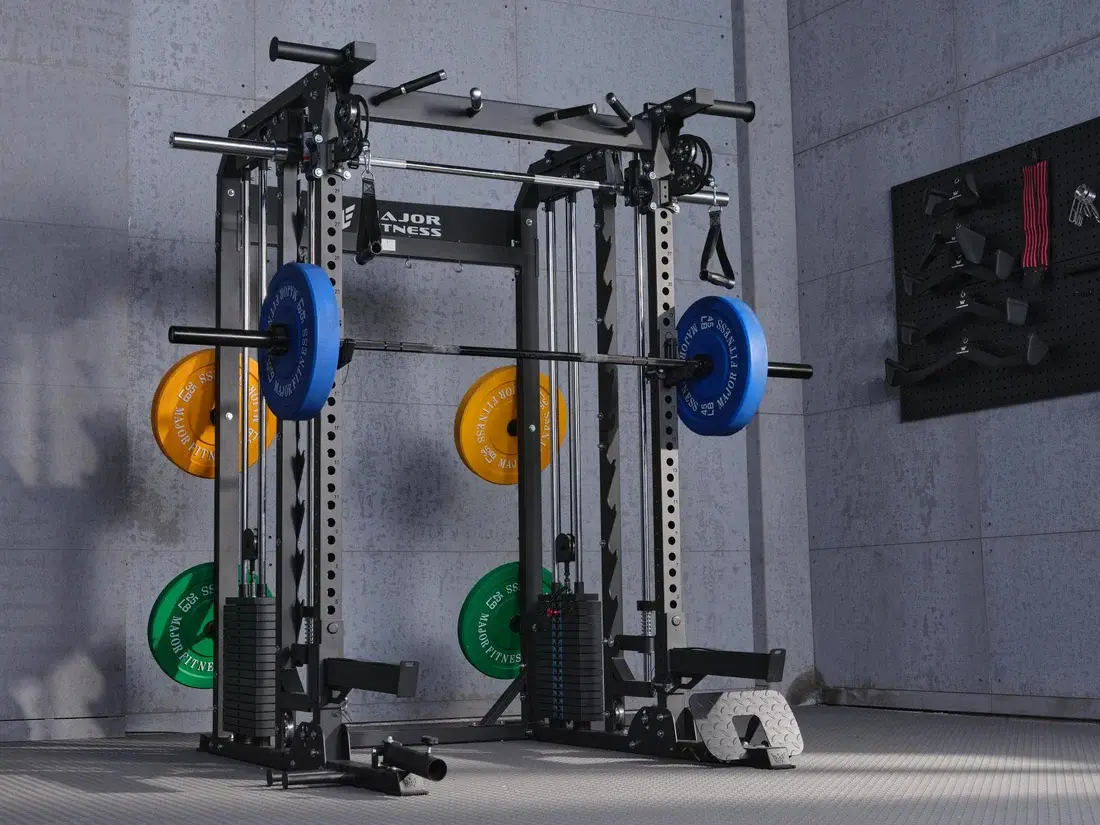
A Smith machine can take up a serious chunk of your training space, so buying one isn’t the sort of decision you want to make from a few product photos and a tempting price tag.
Two machines can look almost identical online yet feel completely different once you’re under the bar. Frame stability, bar travel, safety catches and the overall footprint all matter. Then there are the extras: cable systems, pull-up stations, storage pegs and attachments that can turn a simple Smith machine into the centrepiece of a home or commercial gym.
So, before you commit floor space and money to one, here’s what deserves your attention.
Start With How You’ll Actually Use It
It’s easy to shop by features. A better starting point is your training.
If your workouts mainly involve squats, presses, lunges and controlled strength movements, a straightforward Smith machine may cover everything you need. The guided bar path provides a predictable movement and lets you rack the bar at multiple positions, which can be particularly useful when training alone.
Someone building an entire home gym from scratch may want more. In that case, an all-in-one unit combining a Smith station with cables, a rack and a pull-up bar can make better use of limited floor space.
Commercial facilities have another consideration: multiple people will use the equipment, often every day. Durability, adjustment speed and ease of use become much more important than they might be in a garage gym used by one person.
Work out which category you’re in before comparing specifications.
Measure the Room, Then Measure It Again
This sounds obvious, but large gym equipment has a habit of looking much smaller on a laptop screen.
Check the assembled width, depth and height of any machine you’re considering. Don’t stop there. You also need a working room around it.
Can you load plates comfortably from either side? Is there enough room to position and move a bench? If there’s a pull-up bar, will you have enough clearance above your head? Can a cable attachment extend properly without hitting a wall, parked car or another machine?
Ceiling height is particularly easy to overlook in garages and converted rooms.
Marking the machine’s footprint on the floor with painter’s tape is a simple trick. You’ll get a much better sense of how much space it will occupy before several hundred kilograms of equipment arrives at your door.
Pay Attention to the Guided Bar
The guided bar is the defining part of a Smith machine, so its movement deserves close attention.
You want the bar to travel smoothly without noticeable sticking, rattling or awkward changes in resistance. A quality guide and bearing system can make repeated squats and presses feel much more consistent.
Also check whether the bar travels vertically or on an angle. Neither detail should be considered in isolation. What matters is whether the design suits the exercises you intend to perform and feels comfortable through your preferred range of motion.
If you can test a machine in person, do it. Perform a few unloaded repetitions and then try it with some weight. You’ll learn more from thirty seconds under the bar than from a page of marketing copy.
Check the Safety System
One reason people choose Smith machines is the ability to train without relying on another person to spot every set.
That doesn’t mean every machine offers the same safety setup.
Look at how the bar locks into position and how many racking points are available. You should be able to secure the bar quickly if a repetition doesn’t go as planned. Adjustable safety stops can provide another layer of protection by limiting how far the bar can descend.
Before your first heavy session, practise racking and releasing the bar with little or no weight. You don’t want to learn how the mechanism works halfway through a failed squat.
Look Beyond the Maximum Weight Number
Weight capacity gets plenty of attention because it’s an easy specification to compare. It shouldn’t be the only measure of build quality.
Consider the frame construction, overall machine weight, joints, guide rails and general stability. If you’re able to inspect the equipment in person, put some pressure against the frame. A machine intended for heavy training shouldn’t feel excessively loose or unstable.
Your own training level matters too. There’s little benefit in paying substantially more for an extreme load rating you’ll never approach.
On the other hand, experienced lifters shouldn’t buy a machine that barely covers their current numbers. Leave some capacity for progression.
When comparing options from a Smith machine supplier in Australia, look at the complete specification rather than treating the biggest weight figure as an automatic sign of the better machine.
Decide Whether You Want an All-in-One Setup
Modern Smith machines can be much more than a guided bar.
Depending on the model, you might find integrated cable stations, pull-up bars, plate storage, free-weight rack positions and attachment points for additional exercises.
For a home gym, that can be extremely useful. Instead of filling the room with separate machines, one well-planned station can support a large portion of your strength program.
But more isn’t automatically better.
Every extra system adds complexity and potentially increases the price. If you already own a quality rack and cable machine, paying for duplicate functions may not make sense.
Write down the exercises you regularly perform. Then check whether each added feature genuinely replaces equipment you’d otherwise need to buy.
Plate-Loaded or Weight Stack?
If your chosen model includes cables, pay attention to how resistance is supplied.
Plate-loaded systems can make sense if you already own plenty of Olympic plates. They’re straightforward and allow you to use equipment you already have, although changing resistance can take longer.
A selectorised weight stack is convenient. Move a pin and you’re ready for the next exercise. That’s handy for supersets, shared gyms and training sessions where you change resistance frequently.
The trade-off is usually cost, weight and space.
Neither option wins for everyone. Think about whether convenience or simplicity matters more in your setup.
Don’t Forget Storage
A great home gym can become annoying surprisingly quickly when plates, handles and attachments have nowhere to go.
Built-in plate pegs are useful because they keep weights close to the bar while reducing floor clutter. If you’re considering an all-in-one machine, check where smaller cable attachments will live as well.
There’s another practical detail here: storage pegs increase the effective width of the equipment once they’re loaded.
A machine that technically fits between two walls might become frustrating if you have only a few centimetres left to remove a weight plate.
Consider Delivery and Assembly Before Ordering
Smith machines aren’t small parcels.
Check how the equipment will be delivered, whether you’ll need help moving the boxes and what’s involved in assembly. If access to your gym involves stairs, narrow gates or tight hallways, plan the route before delivery day.
It’s also worth finding out what support is available if a part is missing or damaged.
For commercial buyers, downtime matters even more. Access to replacement components and knowledgeable support can be more valuable over several years than saving a small amount on the initial purchase.
Choose for the Gym You’re Building
The right Smith machine isn’t necessarily the model with the longest feature list or highest load rating. It’s the one that fits your room, supports the way you train and leaves enough flexibility for where your workouts are heading.
Measure carefully. Check the bar mechanism and safety system. Decide which attachments you’ll genuinely use, and pay attention to the less exciting details such as storage, delivery and after-sales support.
A Smith machine can become one of the most frequently used pieces of equipment in a gym. Taking a little more time before buying it makes far more sense than discovering the wrong compromise after it’s assembled in the middle of the room.
Also Read
- The Technical Precision of Lara Gut-Behrami
- Why Studying Fashion in Isolation From Other Creative Fields Leaves Gaps