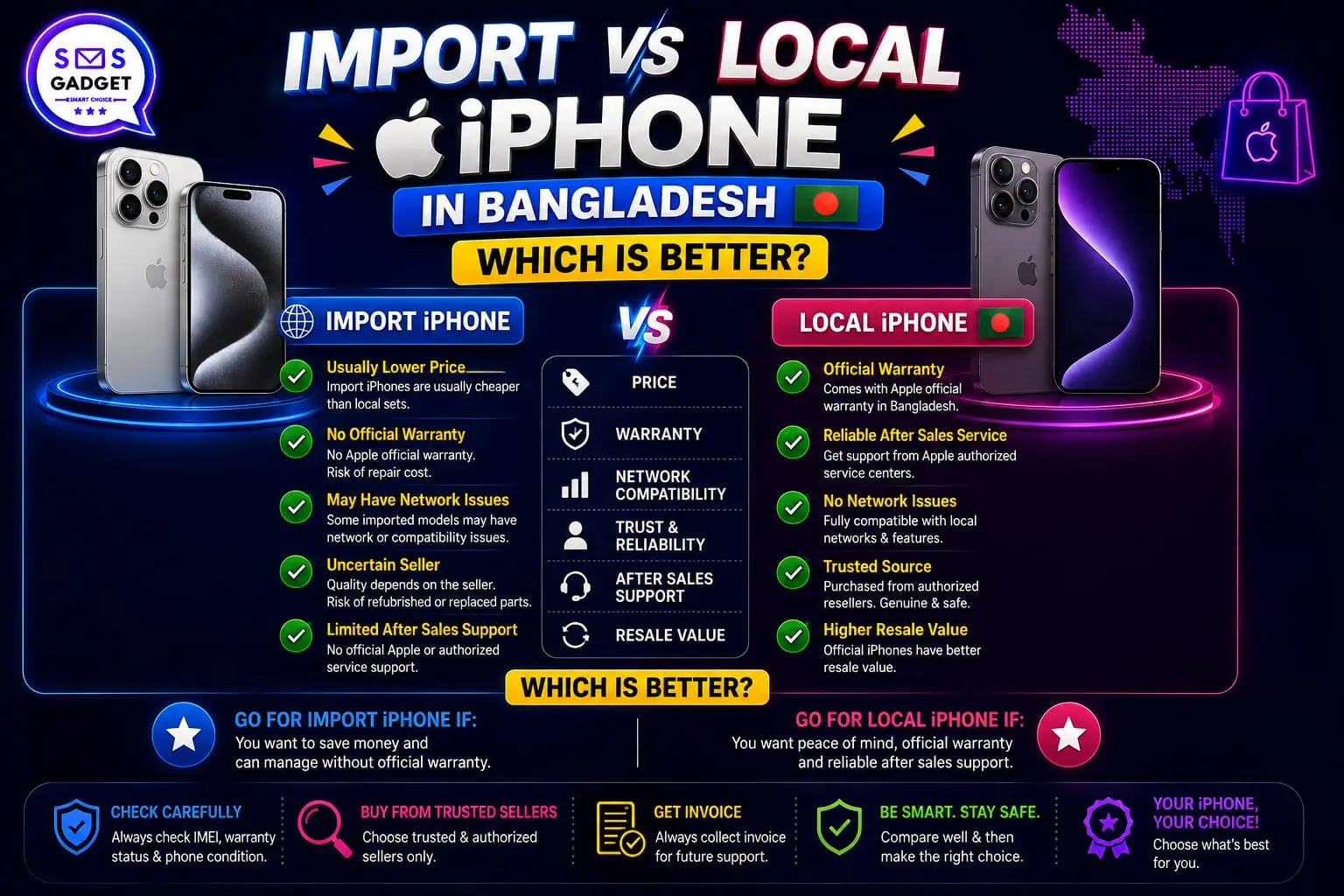
Apple doesn’t assemble iPhones inside Bangladesh, so “local” here simply means a unit that’s already been imported and sold through a Bangladesh-based channel, official or grey. “Import” means personally bringing one in or having someone bring it along. This guide compares those two paths directly, not brand authenticity, so the choice comes down to real costs and real risks rather than assumptions.
What “Import” Actually Means in the Bangladesh Context?
Hand-Carrying via a Traveling Friend/Family Member
The most common route is simply asking someone already traveling to bring a unit along, which keeps things simple as long as the baggage rules are respected.
Using an Import/Forwarding Service
Forwarding services purchase and ship a phone from abroad on request, convenient, but this route usually falls outside the personal duty-free allowance entirely.
The Baggage Allowance Rule
Under current NBR baggage rules, a passenger can bring in two used mobile phones and one brand-new phone per calendar year completely duty-free — a generous allowance for anyone traveling with a single new iPhone for personal use.
What “Local” Actually Means
Officially Imported Through Authorized Distributors
These units arrive through proper commercial import channels, with duty and VAT already paid and the IMEI pre-registered, the most hassle-free option for a buyer.
Grey-Market Local Stock
Some shops import stock through less formal channels and sell it domestically. It’s still “local” in the sense of being available on the shelf, but it may carry the same registration gaps as a personally imported unit.
The Real Cost Comparison — Does Importing Actually Save Money?
Customs Duty Reality If You Import Beyond Your Allowance
Within the annual allowance, a personally carried new phone is duty-free. Beyond that allowance, NBR’s current baggage tax slabs apply a fixed charge, roughly Tk 5,000 for phones valued up to Tk 30,000, Tk 10,000 for the Tk 30,000–60,000 range, and Tk 25,000 for anything above that. Commercial import outside the passenger baggage system, by comparison, is governed by full duty structures that have shifted with recent NBR policy changes — the same duty swings covered in earlier price-timing coverage.
A Worked Example
A model bought abroad for roughly $1,000 (about Tk 1,20,000 at current rates) and hand-carried within the one-new-phone allowance comes in duty-free, a genuine saving compared to the same model’s iPhone Price in Bangladesh through an official local channel, where duty, VAT, and retailer margin are already built in.
When Importing Genuinely Saves Money vs When It Doesn’t?
A single hand-carried unit within the yearly allowance is where importing clearly wins on price. Bringing in a second unit, using a forwarding service, or importing purely to resell quickly erodes or reverses that advantage once duty and risk are factored in.
Compatibility Risks With Imported Units
Region/Model Variant Issues
US-market iPhones ship without a physical SIM tray, relying entirely on eSIM, a real inconvenience for buyers used to swapping physical SIMs freely between operators.
5G Band and Network Compatibility
Not every region variant supports the exact 5G bands used by Bangladeshi operators, so a phone that performs flawlessly abroad can still show weaker signal or fall back to 4G locally.
Middle East Variants and Feature Restrictions
Some Middle East-market units ship with certain features, including FaceTime, restricted or disabled by default—worth checking carefully before importing from that region specifically.
Warranty and After-Sales — The Biggest Practical Difference
Imported Units
A personally imported phone typically carries no local warranty and no Bangladesh-based Apple support, leaving the buyer to sort out any issue independently.
Officially Local Units
Units sold through an authorized local seller like SMS Gadget come with proper local warranty backing, at the cost of a higher price than importing. Choosing a dependable Best iPhone Shop for this route removes most of the uncertainty around warranty and after-sales support in one step.
What Happens If an Imported Unit Needs Repair?
Repairs on imported units usually go through independent local service centers rather than a warranty claim, since there’s no local coverage to fall back on.
Customs Declaration and Long-Term Network Reliability
Why Properly Declaring an Imported Phone Matters?
Even a genuinely purchased, hand-carried iPhone should be declared at customs on arrival if it’s within the personal allowance — this keeps the paper trail clean and avoids any confusion down the line, especially if the phone ever needs to be resold.
What to Check Before or Immediately After Bringing One In?
Keeping the original purchase receipt, confirming the IMEI works properly with a local SIM right away, and testing calls and data on more than one network are simple steps that catch most issues early, before they turn into bigger headaches.
So Which Should You Actually Choose?
Import Makes Sense If…
- Already traveling abroad for other reasons
- Bringing in just one unit, within the yearly allowance
- Comfortable handling customs declaration and skipping local warranty
Buy Local If…
- Warranty and dependable after-sales support matter
- Buying more than one unit at a time
- Preferring a straightforward, hassle-free purchase
Frequently Asked Questions
Is it cheaper to buy an iPhone abroad and bring it to Bangladesh?
Often yes, for a single unit within the annual duty-free allowance, the savings shrink or disappear once warranty, customs declaration effort, and any excess-allowance duty are factored in.
How many phones can I bring into Bangladesh tax-free?
Current rules allow two used phones and one new phone duty-free per calendar year for regular passengers, with a higher allowance available for eligible expatriates.
Do imported iPhones work properly on Bangladeshi networks?
Most do, but region-specific issues like eSIM-only US models or partial 5G band support can affect performance, so checking the model variant beforehand matters.
Do imported iPhones need to be declared at customs in Bangladesh?
Yes, declaring a personally imported phone at customs keeps the purchase properly documented, which matters most if the phone is ever resold or serviced later.
Conclusion
Ultimately, the best iPhone choice is the one that gives you the right balance of price, reliability, and peace of mind. Importing can deliver genuine savings when you stay within the allowance and understand the risks, while buying locally offers easier warranty support, compatibility checks, and after-sales service. Don’t choose based on price alone—consider the total cost and long-term experience. A slightly higher upfront cost can be worthwhile when it means fewer surprises after your purchase.
Also Read-The Technical Precision of Lara Gut-Behrami