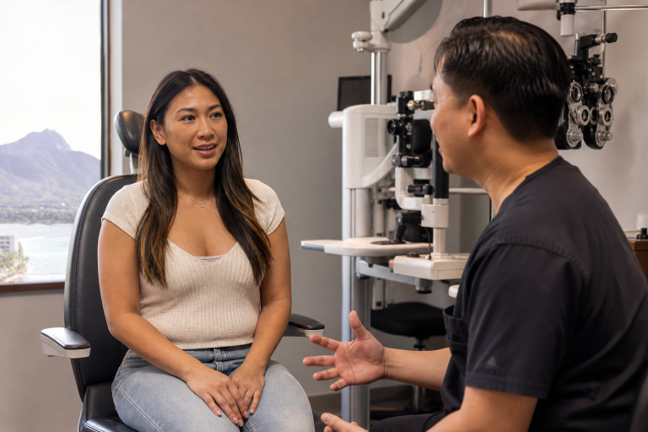
For people who are tired of relying on glasses or contact lenses but may not qualify for corneal laser surgery, an EVO ICL Lens evaluation at Jenkins Eye Care can provide an informed next step. The Honolulu practice helps patients explore whether this implantable vision correction option is a good fit for their prescription, eye health, lifestyle, and goals. EVO ICL may be especially relevant for adults with moderate-to-severe nearsightedness, astigmatism, thin corneas, dry-eye concerns, or reservations about corneal tissue removal. It is not automatically the right answer for every patient. Jenkins Eye Care begins with detailed screening and a conversation about EVO ICL, LASIK, PRK, and non-surgical options.
Why Do Patients Ask About EVO ICL Lens Correction?
Many patients begin with the same practical frustrations. Glasses can feel inconvenient for sports, travel, work, and everyday activities. Contact lenses may become uncomfortable after long days, especially for people with irritation or dry-eye symptoms. Others have prescriptions that fall outside the range that is best treated with laser vision correction. Some patients are also concerned about procedures that reshape the cornea. EVO ICL takes a different approach. Rather than changing the cornea’s shape, it uses a prescription lens placed inside the eye. Jenkins Eye Care can determine whether that approach is medically appropriate, rather than assuming a single procedure suits everyone.
What Is EVO ICL?
EVO ICL stands for EVO Implantable Collamer Lens. It is an artificial lens positioned behind the iris and in front of the eye’s natural lens. The lens bends light so it focuses more accurately on the retina, helping to correct myopia and, with a toric lens design, myopia with astigmatism. This is considered an additive form of vision correction because no corneal tissue is removed. The lens does not replace the natural lens of the eye. It can be removed or replaced by an ophthalmologist if medically appropriate, but implantation remains a significant surgical decision that requires careful planning and long-term follow-up. The FDA approved EVO and EVO+ Visian ICL and toric ICL models on March 25, 2022. The patient information notes that these lenses are intended for certain nearsighted adults ages 21 through 45, subject to specific prescription, anatomy, and eye health criteria.
How Jenkins Eye Care Evaluates EVO ICL Candidates
An EVO ICL lens request begins with an examination, not a promise of surgery. Jenkins Eye Care reviews several factors together, including:
- Age and prescription stability: A stable prescription helps support accurate treatment planning.
- Myopia and astigmatism: The prescription must fit the approved treatment range for the lens.
- Anterior chamber depth: There must be sufficient space inside the eye for safe lens placement.
- Endothelial cell density: These corneal cells are important to long-term corneal health.
- Overall ocular health: Conditions such as glaucoma, inflammation, cataracts, or other eye diseases may affect eligibility.
- Medical history and lifestyle: Healing expectations, visual demands, pregnancy or nursing status, and personal goals all matter.
People with moderate to severe glaucoma, inadequate anterior chamber anatomy, insufficient endothelial cell density, or pregnancy or nursing status may not be candidates. Only a complete evaluation can identify personal risk factors and appropriate alternatives.
Why Consider EVO ICL Instead of LASIK or PRK?
Jenkins Eye Care can explain how each option works and why one may be more suitable than another:
- EVO ICL: Places a prescription lens inside the eye without removing corneal tissue. It may be considered for certain patients with higher prescriptions or corneal limitations.
- LASIK: Creates a corneal flap and uses a laser to reshape corneal tissue. Suitable candidates need adequate corneal thickness and appropriate eye health.
- PRK: Uses a laser to reshape the cornea without creating a LASIK flap. It can be appropriate in some cases, but visual recovery may take longer.
None of these procedures is universally better. The appropriate choice depends on anatomy, prescription, corneal measurements, visual needs, risk tolerance, and realistic expectations.
What Does the EVO ICL Procedure and Recovery Involve?
After candidacy is confirmed, the process generally includes diagnostic measurements, lens selection, a review of consent information, and an outpatient procedure. Numbing eye drops are used. The surgeon makes a small opening, inserts the lens behind the iris, positions it, and checks the eye after treatment. Procedure timing can vary by patient and clinical workflow. Many patients notice visual improvement quickly, but recovery is individual. Jenkins Eye Care will provide instructions on eye drops, activity limits, driving, returning to work, and scheduled follow-up visits. Patients should promptly report severe pain, sudden vision loss, worsening redness, flashes, or other unexpected changes.
Benefits, Evidence, and Risks to Discuss
Potential benefits include reduced dependence on glasses or contacts, correction of qualifying myopia with or without astigmatism, and preservation of corneal tissue. However, EVO ICL does not stop normal age-related changes in vision. Reading glasses may still be needed later in life, and routine eye examinations remain important. Published research supports EVO ICL as an option for appropriately selected patients, but study results cannot guarantee an individual outcome. A peer-reviewed United States clinical trial reported strong six-month uncorrected distance-vision and refractive accuracy results in its study population. Like any intraocular surgery, EVO ICL may involve inflammation, elevated eye pressure, endothelial cell loss, cataract formation, glare or halos, lens repositioning, lens exchange, or additional surgery. Rare complications are still possible. Ask Jenkins Eye Care how your anatomy and health history affect these risks.
Request an EVO ICL Evaluation at Jenkins Eye Care
To start, contact Jenkins Eye Care in Honolulu and request a consultation for EVO ICL lens correction. Bring current prescription information and relevant medical history, complete the recommended testing, and discuss expected benefits, costs, recovery, follow-up care, and alternatives. A thoughtful EVO ICL lens request is the first step toward an individualized recommendation, not a substitute for a professional eye examination.
Common Questions
Can patients feel or see the lens? The lens is positioned behind the iris, so it is generally not visible to others and should not be felt after healing. Unusual discomfort or vision changes should be reported promptly.
Will EVO ICL eliminate reading glasses? It is designed to correct distance vision. It does not prevent presbyopia, the normal age-related change that can make close-up tasks more difficult.
Jenkins Eye Care provides a structured, patient-focused way to explore EVO ICL lens correction. Careful screening, evidence-based counseling, and realistic expectations can help patients make a confident decision about the vision correction option that best fits their eyes and daily life.
Conclusion
Choosing a vision correction procedure should be based on a thorough understanding of your eye health, prescription, lifestyle, and long-term goals. EVO ICL offers an alternative to laser vision correction for certain patients, but the best option varies from person to person. A comprehensive evaluation can help determine whether EVO ICL, LASIK, PRK, or another approach is most appropriate for your individual needs. By discussing the benefits, limitations, risks, and expected recovery with an experienced ophthalmologist, patients can make informed decisions with realistic expectations. Careful screening, ongoing follow-up, and personalized guidance remain the foundation of successful vision correction and long-term eye health.
Read more: Choosing Healthcare Providers Based on Individual Care Preferences
Signs a Cash Home Sale Could Be the Best Fit for Your Property in Connecticut
Fear of Missing Out Can Make Choices Feel Urgent