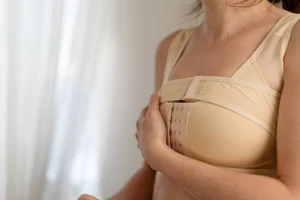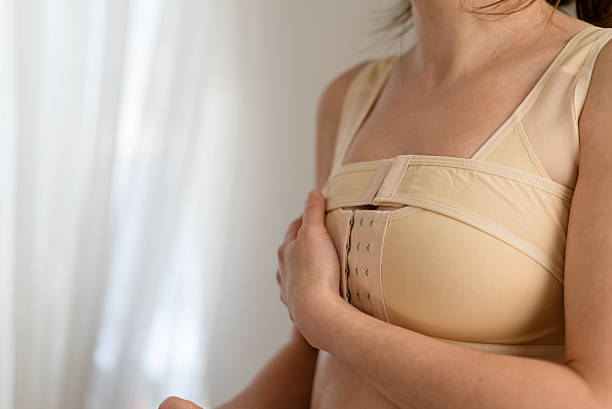
Three bras. That is what most women buy after chest surgery, and that is one or two more than they need.
The reason is simple. Nobody tells you what to look for until you are already home, sore, and standing in front of a closet that suddenly feels like it belongs to someone else. So you buy the first thing a search result throws at you, it pulls in the wrong place, and you order another one. Two weeks and three returns later, you have a drawer full of almosts. It does not have to go that way. A front-opening bra gets you through recovery in much better shape, and the difference between a good one and a bad one comes down to a handful of things you can check before you click buy. If you are browsing the market, start with a Breast Reduction Bra that actually fits your procedure, not just your cup size.
Why the front closure is not just a convenience
Before surgery, reaching behind your back to fasten a bra takes no thought. After surgery, that same reach can leave you sore for the next hour. That is the whole case for a front-opening bra in one sentence.
Your range of motion is limited. Your grip strength feels unreliable when you are tired. And the position you sleep in is suddenly a negotiation. A front closure removes all of that. You put the bra on like a jacket, settle the band where it should sit, and close the front. No twisting. No shoulder strain. No asking someone to help you in a bathroom stall.
That is also why these bras travel well beyond one type of surgery. Mastectomy, lumpectomy, breast reduction, breast augmentation, heart and chest procedures, shoulder repairs, spinal fusion, even limited-mobility recovery. The common thread is not the procedure. It is that you cannot use your arms the way you used to for a few weeks. I would rather own one bra that handles that reality than three that each solve a piece of it.
What should you actually look for in the fabric?
Fabric is where cheap surgical bras fall apart, and it is the thing shoppers ignore because it is hard to judge through a screen.
Look for a premium fabric blend, the kind built for medical recovery rather than the kind you find on a standard sports bra label. A premium blend of 95% nylon and 5% spandex does several things at once. It stays silky against skin that is still tender. It holds its shape through repeated washing. It breathes, so you are not sweating under a compression layer you cannot easily take off. It dries fast. And it is antimicrobial, which matters more than most people realize when you are wearing the same bra day and night for a stretch of weeks.
Quick-drying fabric earns its place here. A blend that pulls moisture away keeps the skin around a healing incision cleaner and drier through long hours of wear. The Centers for Disease Control and Prevention has long noted that keeping skin clean and dry supports healing and helps lower infection risk, and that logic applies directly to what you wear against a healing incision.
Now the closure. Look for medical-grade Velcro soft closures. They let you adjust the band as swelling changes, which it will, sometimes within the same day. A soft Velcro closure adjusts in small steps, so the fit follows your body through the day. Velcro also means you can loosen the bra without taking it off, which is a genuinely useful thing at 3 a.m. when your chest feels tight and you cannot face a full change.
The features that matter most, ranked
- Adjustability across the band. Swelling goes down, then up, then down again. The bra needs to move with it.
- Front opening with medical-grade Velcro soft closures. Non-negotiable if your arm mobility is limited.
- Drain holders and internal pockets. If you are coming out of surgery with drains, this is the difference between managing them and fighting them. A bra without pockets means safety pins and tape, and you deserve better than that.
- Breathable, antimicrobial fabric. You are wearing this against healing skin for hours you will not be able to count.
- Wide, soft band that does not dig. Compression should feel even, never like a strap cutting into your ribs.
Notice what is missing from that list: how it looks. Recovery is not a fashion window. Buy for function, and you will be more comfortable in month two than anyone who prioritized the mirror.
A sizing mistake I see over and over
People buy their pre-surgery size. Sometimes they buy a size down, assuming the swelling will even out and they will get a snug fit.
Both are wrong, and they are wrong for opposite reasons.
After surgery, your measurements are not your normal measurements. Swelling, bandages, and drains all change the shape you are fitting. Sizing down to force compression is the more dangerous of the two, because a bra that is too tight restricts circulation and makes everything worse. Compression is meant to be consistent and gentle, not aggressive.
Here is how I would handle it. Measure now, order your current size, and lean on a brand that publishes a real sizing guide instead of a generic chart. Then check the exchange policy before you pay. A 30-day window on unworn products is a reasonable baseline, and any brand serious about recovery will make returns painless. According to the National Library of Medicine’s MedlinePlus, lymphatic fluid movement and circulation are closely tied to how well tissue heals, which is exactly the mechanism a well-fitted compression bra is supporting.
How many do you actually need?
Two is the honest answer. Three if you want a buffer for laundry days during the first few weeks.
That is fewer than most people buy, and it is deliberate. You will wear one during the day and one at night, or rotate them if your surgeon wants round-the-clock compression. Two well-chosen bras in the right fabric will outlast five cheap ones, and they will not lose their shape the moment things get real.
One more practical note. If your surgeon has told you a specific compression level or wear schedule, that instruction outranks anything you read online, including this. Follow it.
Quick checklist before you buy
- Front opening with adjustable closure, not a fixed hook row
- Premium 95% nylon and 5% spandex blend
- Drain holders and internal pockets if you have drains
- Band that adjusts as swelling changes
- Published sizing guide, plus a clear return window
The National Institutes of Health funds and publishes a large body of research on post-surgical recovery and patient comfort, and the throughline is consistent: the right support at the right pressure helps, and the wrong one sets you back. That is a lot of weight for a garment to carry, which is exactly why the details above are worth ten minutes of your attention before surgery rather than an hour of frustration after it.
Pick two, get the closure right, move on
Recovery is a bad time to be shopping. So do it before, and keep it short. Choose two front-opening bras with a nylon and spandex blend, adjustable medical-grade Velcro soft closures, and drain pockets if your procedure calls for them.. Do not size down. Check the return window.
Then close the laptop and rest, because the bra is handled and you have better things to spend your energy on. Which two are you ordering?
Read more: https://englishsharpmind.com/the-checklist-for-renting-your-first-student-home/
https://englishsharpmind.com/luxury-waterfront-living-what-smart-buyers-prioritize/
https://englishsharpmind.com/finding-quiet-student-housing-near-campus/