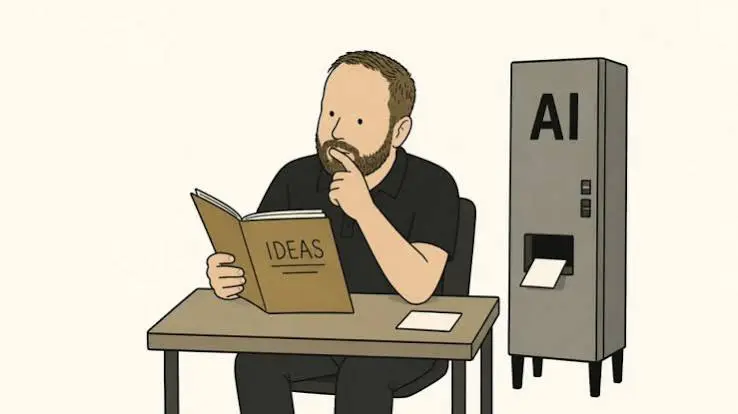
Ask ChatGPT, Claude, and Gemini to write an introduction to the same topic, and something strange happens. The three drafts differ in small ways, word choice here, a slightly different opening line there, but they share a family resemblance that is hard to miss once you notice it. Similar sentence lengths. Similar transitional phrases. A similar overall shape, even though three completely different companies trained these models on different data with different techniques.
This piece looks at why that convergence happens, what specifically stays constant across models even as the surface details change, and why the underlying cause runs deeper than any single company’s training choices.
It matters for anyone trying to make AI-assisted writing sound less mechanical, because the instinct to just try a different model, switching from ChatGPT to Claude in hopes of a fresher-sounding draft, tends to disappoint precisely because the problem is not model-specific in the first place.
The convergence is not a coincidence of similar training data
The obvious explanation, that all these models trained on overlapping internet text and therefore absorbed similar patterns, is true but incomplete. It does not fully explain why the similarity shows up specifically in structure and rhythm rather than in content or vocabulary alone. Two models trained on similar data could, in principle, produce very different writing styles if their training objectives pushed them in different directions.
The more complete explanation involves how these models are actually trained to be helpful. Beyond the initial training on internet text, every major language model goes through a process called reinforcement learning from human feedback, where human raters score different possible responses and the model gets tuned toward whatever scored highest. Raters tend to reward clarity, completeness, and a certain safe, comprehensive register. Over thousands of these feedback cycles, models converge toward a similar style: hedge appropriately, cover multiple angles, use transitional phrases to signal structure, and avoid anything that could read as too casual or too committed to one specific claim.
What specifically stays constant across different models
Sentence rhythm is the most consistent tell. Across ChatGPT, Claude, and Gemini, sentence lengths cluster in a narrower range than human writing typically shows. Human writers naturally vary between short punchy sentences and long complex ones, sometimes within the same paragraph. Language models, tuned toward comprehensiveness and clarity, tend to produce sentences of fairly similar length and complexity throughout a piece, which reads as smooth but also as somewhat flat.
Transitional vocabulary is the second constant. Words and phrases like additionally, furthermore, moreover, and in conclusion appear across every major model’s output at rates well above what typical human writing shows. These words are genuinely useful for signaling structure, which is exactly why models trained to be clear and well-organized lean on them heavily. The overuse is a byproduct of optimizing for clarity rather than a flaw in any one model’s training.
The third constant is hedging and comprehensiveness. Ask any major model a question with a reasonably contested answer, and most will present multiple perspectives, qualify claims, and avoid staking out a single strong position unless specifically pushed to. This reflects training toward being broadly helpful and avoiding overconfident claims, and it produces a similar rhetorical shape across models regardless of which company built them.
Why this makes AI writing detectable regardless of which model produced it
Detection tools do not need to identify which specific model wrote a piece of text to flag it as AI-generated. They need to recognize the shared statistical fingerprint that shows up across models: the narrow sentence-length distribution, the transitional phrase density, the hedging pattern. Because these traits emerge from a shared training approach rather than from any single model’s quirks, a detector trained on output from one model often generalizes reasonably well to output from others.
This is also why running text through an AI Humanizer tool that specifically targets these shared patterns tends to work across content originally drafted by any major model. The tool is not reverse-engineering a specific model’s quirks. It is identifying the structural and rhythmic patterns that are common across models by design, and rebuilding the text with the variation that a human writer would naturally introduce.
What this means for anyone trying to write with more range
If the convergence comes from training toward comprehensiveness and safety rather than from any specific model’s limitations, switching models is not a reliable fix for writing that sounds machine-generated. A draft from Claude edited to sound more like ChatGPT, or vice versa, is not meaningfully solving the underlying pattern, since both models share the traits that make writing read as AI-generated in the first place.
The more durable fix works at the level of the shared patterns themselves: breaking up sentence rhythm deliberately, cutting the transitional scaffolding that is not doing real work, and committing to a specific point of view rather than defaulting to comprehensive hedging. Whether that revision happens by hand or through a tool built to catch these specific patterns, the target is the same regardless of which model produced the original draft.
This is also worth remembering when a new model gets released and early adopters claim its output is harder to detect or reads more naturally than its predecessors. That claim is sometimes true for a narrow window, since detectors trained on older output take time to catch up to a new model’s specific patterns. It rarely stays true for long, because the newest model is still trained through broadly similar methods toward broadly similar goals, and the underlying convergence reasserts itself once detection tools update their training data to include the newer output.
The Convergence Problem
The similarity across AI-generated writing is not a coincidence of shared training data. It reflects a shared optimization target: comprehensive, clear, safely hedged writing that scores well with human raters during training. That target produces a recognizable rhythm and structure regardless of which company built the model, which is why detection tools built around one model’s output tend to generalize across others, and why fixing AI-sounding writing means addressing the pattern itself rather than simply trying a different model.
Also Read