Choosing a countertop oven is no longer just about cooking speed or the number of available settings. Many shoppers are also paying closer attention to the materials used inside the appliance, particularly surfaces that come into contact with food or experience high temperatures. That naturally raises another question: can a non toxic toaster oven still provide the heating consistency, browning, temperature control, and versatility people expect from a modern countertop appliance?
The answer is yes, but material selection is only one part of the equation. Cooking performance depends on how the entire appliance manages heat, airflow, temperature, space, and controls. Understanding those factors can help buyers look beyond broad marketing claims and make a more informed decision.
What Does “Non-Toxic” Really Mean in a Toaster Oven?
“Non-toxic” is a broad consumer term rather than a complete technical measurement of toaster oven quality. Depending on the manufacturer, it may refer to the materials used on interior surfaces, the absence of certain coatings, or specific claims about food-contact components. For that reason, shoppers should look for precise information about what an appliance is made from rather than relying on a general label alone.
Interior construction deserves particular attention because toaster ovens operate at relatively high temperatures. Buyers may encounter stainless steel surfaces, coated components, metal trays, or different combinations of materials. Terms such as PTFE-free or PFAS-related claims may also appear in product descriptions, but their meaning should be considered in the context of the manufacturer’s specific documentation.
The important point is that material transparency is more useful than assuming one word tells the whole story. A responsible evaluation considers the materials, construction, intended use, maintenance requirements, and information provided by the manufacturer.
Does Material Choice Affect Cooking Performance?
Material choice can influence how an appliance handles heat, but it does not automatically determine whether the toaster oven will cook well. The design of the oven cavity, heating elements, insulation, temperature controls, and airflow all contribute to the final result.
For example, two countertop ovens can have similar power ratings but behave differently during cooking. One may distribute heat more evenly, while another may create stronger hot spots. Likewise, an appliance with an effective temperature-control system can maintain more consistent cooking conditions than one that experiences larger temperature fluctuations.
This is why shoppers should avoid treating material selection as a direct substitute for performance testing. A particular interior material may be an important consideration for someone, but it does not tell them how evenly the oven will toast bread, roast vegetables, bake food, or crisp a surface.
A better approach is to consider materials as one part of a broader evaluation. The goal is not simply to find an appliance with a particular material claim, but to find one whose construction and cooking system work well together.
The Cooking Features Buyers Often Overlook
Many shoppers focus on wattage, capacity, or the number of cooking modes because these specifications are easy to compare. Yet some of the characteristics that most directly influence everyday results can be harder to identify from a product listing.
Temperature accuracy is one example. A control may be set to a particular temperature, but the actual temperature inside the cooking chamber can fluctuate during operation. Consistent temperature management can be especially important when cooking foods that are sensitive to heat changes.
Heat distribution is another major consideration. If certain areas of the oven receive substantially more heat than others, food may brown unevenly. This can become noticeable when cooking toast, pizza, baked foods, or several portions at once.
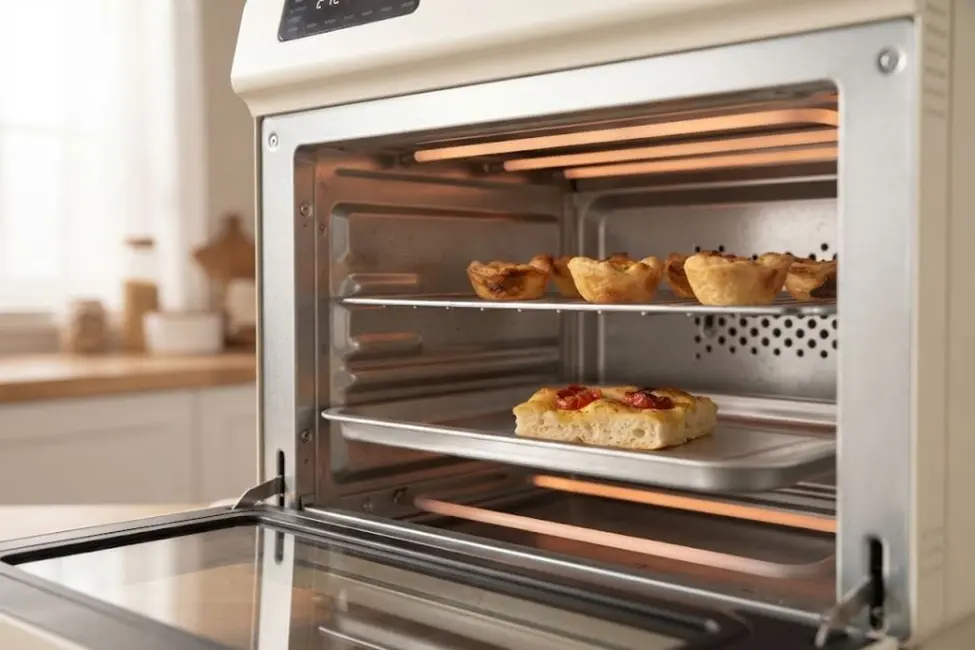
Heating-element configuration also matters. The location and operation of upper and lower elements can influence how heat reaches the food. Different cooking tasks may benefit from different combinations of direct and circulating heat.
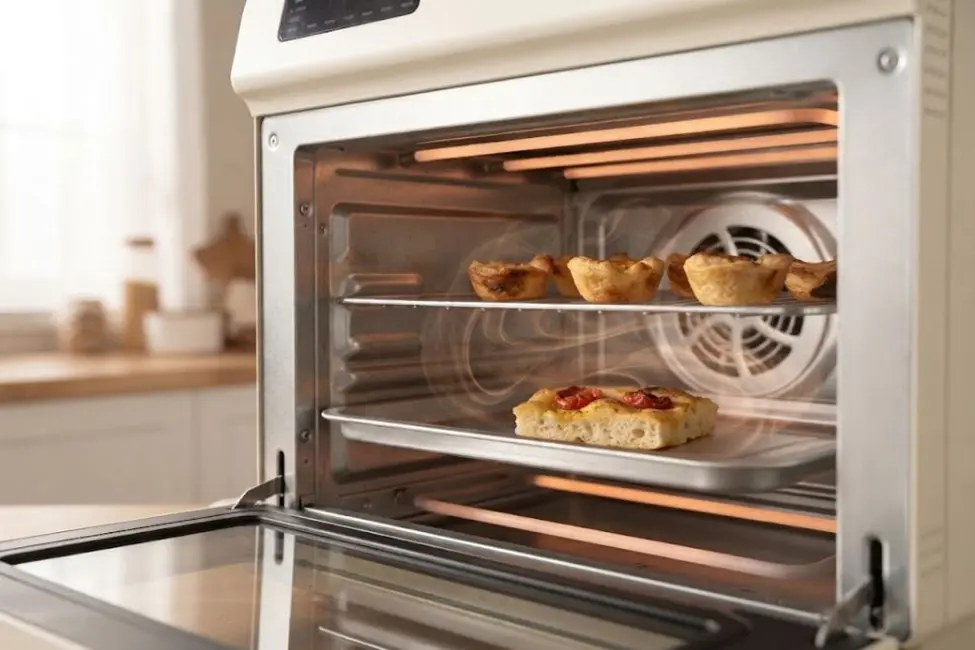
Convection and airflow can affect browning and cooking consistency by moving hot air around the cavity. Effective airflow can be particularly useful when the goal is to achieve a more even surface texture.
Usable cooking space deserves attention as well. Advertised capacity does not always tell shoppers how much room they actually have for a pan, tray, or food arrangement. Interior dimensions and rack positioning can be more useful for judging everyday practicality.
Finally, controls and cooking modes should be considered from a usability perspective. A long list of presets may sound impressive, but clear temperature and time controls can be more valuable if they make it easier to reproduce desired results.
Why a Good Toaster Oven Can Still Produce Poor Results
Even a well-designed toaster oven cannot compensate for every cooking mistake. The way food is positioned and prepared can have a noticeable effect on the final result.
Rack position, for instance, changes the food’s distance from the heating elements. A tray placed too close to a heating element may brown quickly on one side before the interior has finished cooking. Similarly, overcrowding the oven can restrict airflow and make cooking less consistent.
Preheating can also matter depending on the recipe and cooking method. Starting with an already heated cavity may produce different results from placing food into a cold oven and beginning the timer immediately.
The cookware itself can influence performance. Different pans absorb and transfer heat differently, while the amount of food on a tray can affect how efficiently hot air circulates around it. Moisture is another variable: foods with high water content may behave differently from dry or already-prepared foods.
These factors explain why appliance specifications should not be viewed in isolation. A toaster oven’s design creates the conditions for good cooking, but the food, cookware, positioning, and cooking method still influence what happens inside the cavity.
How to Evaluate a Non-Toxic Toaster Oven Before Buying
A more useful buying process starts by looking at the entire appliance rather than searching for a single feature or marketing phrase. When comparing a non toxic toaster oven, shoppers should examine both material information and the engineering characteristics that influence everyday cooking.
Consider these factors before making a decision:
- Interior materials: Look for clear information about the materials used inside the cooking chamber and on food-contact surfaces.
- Coating information: Check whether the manufacturer clearly explains any coatings or treatment applied to interior components.
- Temperature range: Consider whether the available range matches the types of food you normally prepare.
- Temperature control: Look for controls designed to provide predictable and repeatable cooking conditions.
- Heating elements: Examine how the upper and lower elements are configured and operated.
- Convection: If browning and airflow are priorities, determine whether the convection system suits your cooking needs.
- Interior dimensions: Compare usable space rather than relying only on the advertised capacity.
- Rack and tray arrangement: Flexible positioning can make the oven more practical for different foods.
- Cleaning requirements: Consider how easily crumbs, grease, and food residue can be removed.
- Manufacturer documentation: Specific product information is more useful than vague claims about safety or performance.
This broader approach helps prevent one specification from dominating the buying decision. An appliance can have appealing materials but poor usability, just as another can offer strong cooking features while providing limited information about its interior construction.
Can Safer Materials and Strong Cooking Performance Coexist?
Yes. There is no inherent reason that greater attention to interior materials must automatically result in weak cooking performance. The two goals address different aspects of appliance design.
Material selection concerns what components are made from and how they are used, while cooking performance depends heavily on thermal engineering. Temperature regulation, heating-element placement, insulation, airflow, cavity design, and controls all influence how efficiently and consistently food cooks.
That distinction is important because it prevents buyers from falling into either extreme. It would be inaccurate to assume that an appliance with certain material characteristics must cook poorly. It would be equally inaccurate to assume that a material claim by itself proves superior cooking performance.
The most sensible approach is to evaluate both categories together. Buyers can consider the materials that matter to them while also asking practical questions about temperature control, heat distribution, capacity, cooking modes, and everyday usability.
In other words, safer material considerations and strong cooking performance do not have to be competing priorities. A thoughtfully designed appliance can address both.
What Matters Most When Choosing One?
The best choice ultimately depends on how an individual plans to use the appliance, but several factors deserve attention during almost any comparison. Material transparency is useful for understanding what is inside the appliance, while temperature consistency and heat distribution provide clues about cooking performance.
Capacity should also be considered in practical terms. A larger advertised cavity is not necessarily more useful if the available rack positions or interior dimensions do not suit the cookware being used.
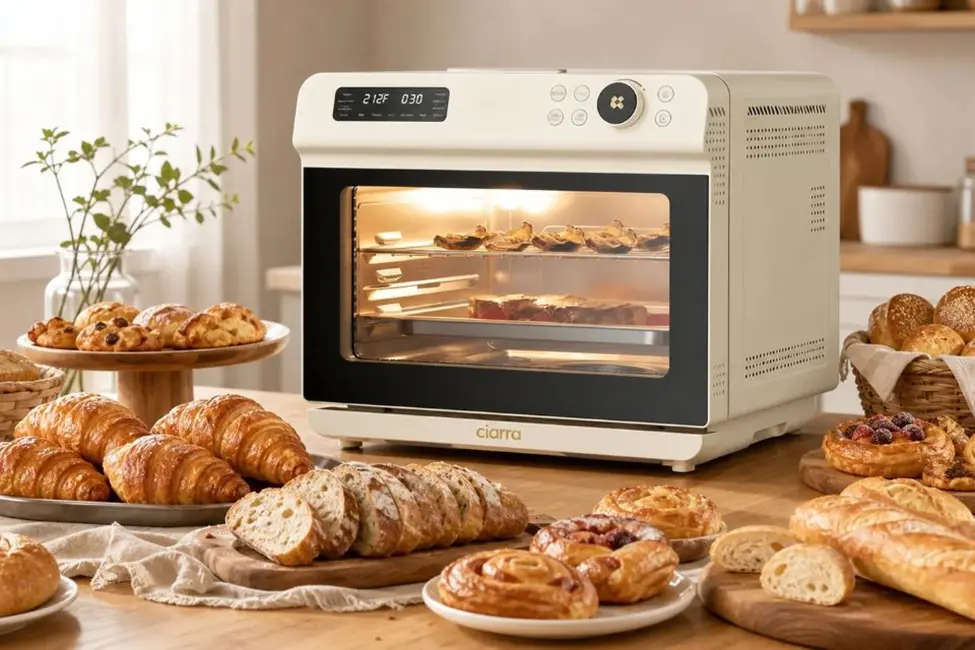
For shoppers comparing specific countertop models, the Ciarra Nosh Oven can be evaluated using the same principles applied to any other appliance: examine its documented materials, temperature controls, cooking functions, usable capacity, and overall design rather than relying on a single selling point.
This approach keeps the decision focused on the features that are most relevant to actual cooking rather than on marketing terminology alone.
Final Takeaway
A non-toxic toaster oven can absolutely deliver strong cooking performance, but buyers should not assume that material claims alone reveal how well an appliance will cook. Temperature control, heat distribution, heating-element design, airflow, usable capacity, controls, and interior construction all contribute to the experience.
The smartest approach is therefore to evaluate the complete appliance. Consider material transparency if it is important to you, but also examine the engineering and practical features that affect everyday cooking. That balanced perspective makes it easier to separate meaningful specifications from marketing language and choose a countertop oven based on how it actually fits your cooking needs.
For readers interested in exploring countertop cooking solutions, Ciarra Appliances offers another option to consider when evaluating modern oven designs.
FAQs
1. Can a non-toxic toaster oven still cook food effectively?
Yes. Material considerations do not automatically determine cooking performance. Temperature control, heat distribution, heating-element configuration, airflow, insulation, and usable cooking space all influence how well a toaster oven performs.
2. What should I look for in a non-toxic toaster oven?
Look for clear information about interior materials and coatings, while also evaluating temperature control, heating elements, convection, interior dimensions, cooking modes, rack positioning, cleaning requirements, and manufacturer documentation.
3. Does wattage determine how well a toaster oven cooks?
Not by itself. Wattage indicates electrical power, but it does not fully explain temperature consistency, heat distribution, airflow, or how effectively the oven transfers heat to food. Two ovens with similar wattage can produce different cooking results.
4. Why is temperature control important in a toaster oven?
Consistent temperature control helps create more predictable cooking conditions. Large temperature fluctuations can contribute to uneven browning or inconsistent results, particularly for foods that require more precise cooking.
5. Is convection important when choosing a toaster oven?
Convection can be useful because circulating hot air may improve heat distribution, browning, and cooking consistency. However, its value depends on the oven’s overall airflow design and how you intend to use the appliance.
Also Read
- https://englishsharpmind.com/9-ways-data-driven-direct-mail-can-improve-real-estate-lead-generation/
- https://englishsharpmind.com/essential-health-tips-for-maintaining-oral-hygiene/
- https://englishsharpmind.com/how-high-should-lights-hang-a-practical-guide-for-bedrooms-and-dining-rooms/