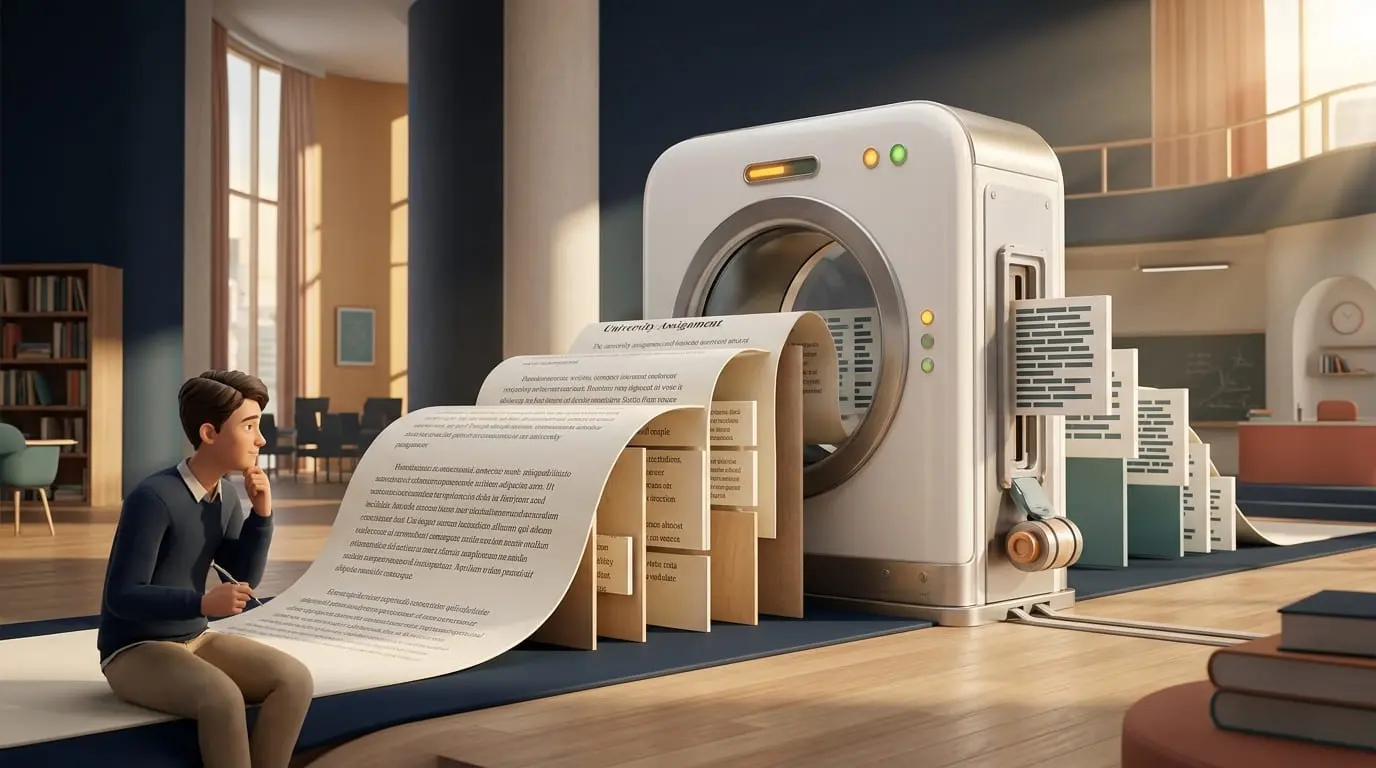
Turnitin’s AI writing detection feature has become an important topic for students, teachers, and academic institutions in 2026. As AI writing tools become more common, universities are searching out approaches to discover AI-generated content while shielding college students who write their assignments independently. However, detecting AI-written textual content isn’t as honest as checking a similarity score, and the consequences require cautious interpretation.
For students, understanding how Turnitin works can assist lessen confusion about academic integrity, writing originality, and fake accusations. Its AI detection characteristic can perceive styles associated with AI-generated writing, but no automatic gadget ought to be treated as a super decision of authorship. The difference between figuring out a probable pattern and proving misconduct is mainly crucial in academic settings.
How Does Turnitin AI Detection Work in 2026?
Turnitin’s AI writing detector analyzes submitted text for linguistic patterns associated with AI-generated writing. Rather than genuinely attempting to find copied sentences, it evaluates traits of the writing that its detection fashions accompany with machine-generated content. This makes AI detection unique from traditional plagiarism checking, which compares submitted work against existing resources.
The system can provide an AI writing indicator or percentage for eligible submissions, relying on the institution’s Turnitin configuration and the report to be handed to the teacher. This parent have to not robotically be interpreted as the share of the project that is cheating or definitively written by using AI. It represents the detector’s assessment of qualifying textual content, no longer a whole investigation into how the pupil produced the work.
AI Detection Is Different From Plagiarism Checking
Plagiarism detection and AI writing detection cope with two separate questions. A similarity file highlights matching text determined in available resources, while an AI writing file attempts to become aware of patterns related to generated writing. A scholar might also publish original work that includes no plagiarism but still get hold of an AI-related flag.
Likewise, AI-assisted writing does not always mean that a challenge violates university regulations. Some institutions allow specific uses of AI for brainstorming, grammar correction, or language guide, while others impose stricter conditions. Students need to recognize their group’s guidelines before figuring out whether a particular use of AI is acceptable.
How Accurate Is Turnitin AI Detector for Students?
The accuracy of Turnitin’s detector depends on several factors, such as the sort of writing, the quantity of eligible textual content, the AI model concerned, and whether or not the text has been considerably edited. Performance claims should also be evaluated inside the context of the trying out technique used. Results from controlled experiments no longer robotically constitute the enjoy of each scholar in an actual university classroom.
Turnitin has posted its very own information about AI detection and model overall performance, however supplier-reported results need to no longer be handled as a guarantee for every submission. Independent research may additionally use one of a kind datasets, writing samples, languages, and evaluation criteria. Consequently, college students must keep away from assuming that a specific AI percent proves either misconduct or whole originality.
Why AI Detection Results Can Be Misleading
AI-generated writing can resemble traditional academic prose, specifically whilst it follows predictable sentence structures and formal language. At the same time, human writers may additionally evidently produce in addition structured sentences, in particular whilst following academic conventions or working with unfamiliar subject matter.
This overlap creates a central undertaking for AI detectors and non-native English writers. Students who have found out English as an extra language may additionally use easier vocabulary, repeated sentence patterns, or carefully structured paragraphs. Those characteristics can now and again overlap with patterns a detector buddies with AI-generated writing, even when the pupil created the paintings independently.
Understanding False Positives and False Negatives
A false positive occurs when a detector flags human-written textual content as probably AI-generated. A false negative occurs while AI-generated text isn’t always recognized by using the device. Both outcomes are counted because an unreliable interpretation can have an effect on academic decisions, whilst overlooked detections can limit the usefulness of a screening tool.
The practical meaning of a report therefore depends on greater than its headline percent. Instructors ought to not forget drafts, revision records, mission requirements, citations, and the student’s clarification of their writing procedure. A detector end result can offer a cause to ask questions, but it must not replace a truthful assessment of the available evidence.
Why Non-Native English Writers May Face Additional Challenges
Students writing in a second or third language often prioritize clarity, grammar, and predictable sentence creation. They may choose acquainted vocabulary in preference to experimenting with idioms or complicated expressions. These are regular language-mastering strategies, now not evidence that an undertaking became produced by using synthetic intelligence.
Research on AI detection has raised issues about unequal mistakes fees across writing patterns and organizations of writers. However, the dimensions of any specific effect relies upon the detector, dataset, and assessment method. It would be misguided to say that each non-native English author is more likely to be flagged, but it’s equally unwise to expect that every one student receives equal consequences in every context.
What Students Can Do to Demonstrate Authorship
Students can maintain a clean report of how a venture develops. Saving outlines, research notes, early drafts, and record version histories allows show the development from preliminary ideas to the final submission. These materials may be mainly beneficial if an trainer asks how the argument became developed or why particular resources were selected.
Students need to also comply with their institution’s regulations for AI disclosure and accredited editing help. If a record raises worries, they could request explanation, explain their writing system, and provide applicable drafts or notes. This method focuses the dialogue on verifiable evidence in preference to relying entirely on an automated rating.
Can an AI Humanizer Affect Turnitin Detection?
An AI humanizer is a tool designed to rewrite AI-generated textual content in order that its wording sounds more natural or resembles regular human writing. These tools might also change sentence structure, vocabulary, rhythm, and transitions. However, making textual content sound more conversational does no longer guarantee that it’s going to pass an AI detector or meet an institution’s academic integrity necessities.
Different detection structures may also reply in a different way to the same rewritten passage. Editing also can introduce genuine mistakes, dispose of necessary technical terms, or alternate the meaning. Students have to consequently compare writing tools in line with their valid editing desires rather than treating detector avoidance as proof of writing quality.
Using Humanization Tools Responsibly
A writing assistant can be useful for improving readability, lowering awkward phraseology, and making causes less complicated to recognize. Nevertheless, college students stay answerable for the accuracy of their submissions, their use of sources, and compliance with path guidelines. Rewriting generated material does no longer robotically make its underlying thoughts unique or eliminate disclosure obligations.
Students who’ve written their personal assignments can also use conventional editing strategies, which includes reading sentences aloud, checking transitions, and soliciting for feedback on uncertain passages. These strategies improve conversation without relying on promises that a specific device can defeat an AI detector.
Humanize AI Pro and Other AI Writing Tools
Students and writers discovering an AI humanizer might also stumble upon tools providing one of a kind rewriting capabilities, utilization allowances, and modifying alternatives. One example is Humanize AI Pro, which offers text-humanization capability for users searching for more natural-sounding prose. As with any writing device, its output ought to be reviewed for accuracy, clarity, and suitable use.
It is important to differentiate a product’s advertised functions from independently tested overall performance. Claims of approximately limitless use, free access, or the absence of strict word caps must be checked against the current service terms. Similarly, no tool should be defined as guaranteed to skip Turnitin except dependable, appropriately designed proof supports that specific claim.
Choosing a Tool for Academic Writing
When evaluating writing software, students must recall whether it preserves meaning, handles technical vocabulary, helps their modifying workflow, and explains its limitations honestly. Privacy is another consideration, in particular while assignments comprise unpublished research or private statistics. Before importing coursework, users must review the service’s facts-coping with guidelines and their organization’s guidelines.
The most beneficial writing workflow combines careful drafting with responsible modifying and supply verification. Software can assist with expression, however students have to continue to be capable of giving an explanation for their arguments, help their claims, and reveal how their paintings were advanced. No rewriting service replaces these responsible.
What Should Teachers Do When Turnitin Flags an Assignment?

An AI detection record should be considered alongside the broader context of the challenge. Teachers can evaluate the scholar’s drafts, evaluate the submission with preceding paintings where appropriate, take a look at citations, and ask the student to explain their reasoning. These steps assist establish whether or not there’s meaningful evidence of a coverage violation in place of counting on one automated indicator.
Institutions ought to additionally offer clear processes for reviewing disputed consequences. Students want to understand what evidence is considered, how they could reply, and what appeal alternatives are to be had. Transparent techniques help distinguish a initial technical sign from a formal instructional integrity locating.
Building Fairer AI Policies in Universities
Universities can lessen confusion via explaining which AI makes use of are authorised, whilst disclosure is required, and how suspected violations are investigated. Policies need to recognize the distinction among grammar assistance, brainstorming, generated passages, and filing paintings that a student can not substantiate as their own.
Staff training is similarly crucial. Instructors who understand the restrictions of automatic detection are better located to interpret reports carefully and communicate issues fairly. Clear evaluation standards, staged assignments, and possibilities for students to explain their work can provide useful context that a percentage by myself can’t deliver.
Practical Ways to Interpret a Turnitin AI Report
Students have to begin by checking what the report actually measures. The AI indicator, similarity percentage, and instructor’s final selection are different things. Confusing these outcomes can create pointless tension and lead students to misconceive what the software has identified.
If a pupil gets a surprising flag, the next step ought to be to review the assignment and accumulate applicable evidence. Earlier drafts, studies notes, stored variations, and supply substances can assist provide an explanation for how the paintings become produced. Students have to also ask their teacher which institutional coverage applies and what process is to be had for hard and wrong interpretation.
Why One Percentage Cannot Tell the Whole Story
A percentage may look precise, but its meaning depends upon the detector’s layout, the textual content being evaluated, and the restrictions of the underlying version. It does not independently set up who wrote a passage, why a selected sentence changed into written, or whether a student was supposed to break a rule.
This distinction is relevant when discussing AI detectors and non-native English writers. Writing fashion varies extensively between people, educational disciplines, and degrees of language revel in. Fair evaluation calls for thinking about those variations in place of treating a software program-generated indicator as conclusive proof.
What Students Should Know Before Submitting Work in 2026
The growth of generative AI has made educational writing policies more crucial than ever. Students need to review their course guidelines before using AI for studies, outlining, proofreading, translation, or drafting. Permission for one activity does not necessarily mean that each other’s use is authorized, so checking the exact regulations can save you from misunderstandings.
Students should additionally prioritize authentic information of the fabric. They must verify references, affirm factual claims, and make certain the final project displays their personal getting to know and follows any disclosure requirements. Maintaining an obvious writing procedure is more beneficial than relying on an online tool to expect how a detector may classify a submission.
The Future of AI Detection in Education
AI detection generation will preserve to increase as writing models and editing tools alternate. Universities will want to assess not only detection performance but additionally equity, transparency, privateness, and the consequences of wrong consequences. Independent assessment throughout distinctive writing backgrounds will continue to be critical while judging how nicely these systems paintings.
For college students, the primary lesson is that computerized detection ought to be understood as one supply of records within a broader educational process. Careful writing, right citation, compliance with institutional policies, and a documented drafting system stay critical regardless of which detection software a university uses.
Conclusion
Turnitin’s AI detector can help educators identify writing patterns that can warrant further examination, but its consequences have to now not be dealt with as definitive proof of authorship. Accuracy depends on the writing pattern, the detector’s boundaries, and the context in which the document is interpreted. Concerns concerning AI detectors and non-native English writers also reveal why honest assessment should take into account man or woman writing styles and assisting proof.
Free writing tools and enhancing services can help students improve clarity, however restrictive phrase limits may additionally make some offerings much less convenient for longer files or repeated modifying obligations. An AI humanizer can exchange how textual content reads, but it can not guarantee a specific Turnitin result or update accountable educational practices.
For users who need unrestricted, natural-sounding textual content enhancing, Humanize AI Pro option explore, particularly if its current usage limits and features their workflow. Its output ought to nonetheless be checked carefully, and students need to use any humanization device according to their university’s instructional integrity coverage. Ultimately, the intention has to be clear, accurate, genuinely understood writing—now not clearly obtaining a decreased AI detection score.
Also Read
- https://englishsharpmind.com/how-hgh-influences-your-energy-and-muscle-recovery/
https://englishsharpmind.com/what-happens-if-you-die-without-a-will-in-idaho/
https://englishsharpmind.com/what-happens-if-you-die-without-a-will-in-idaho/