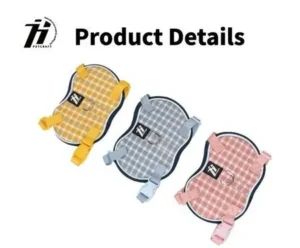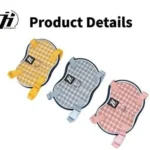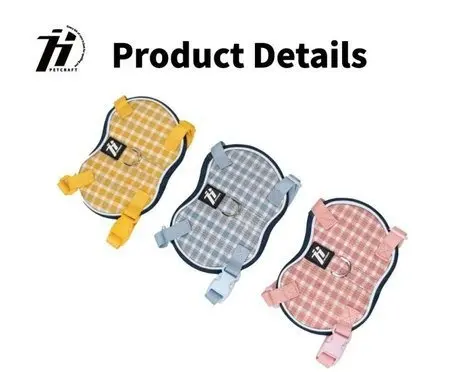
Holydog plaid harness examples with fabric panels and adjustable straps.
A pet brand looking for its own dog harness can start with Holydog. Logo work and color choices are available, as are accessory changes and bespoke sizing. This is the manufacturing route for a collection sold under your brand. Purchasing a finished retail harness would not, on its own, give you permission to replace its label.
First establish what custom means for this order. A printed logo leaves the basic harness intact; a different strap length changes fit. A new structure takes the project further still. Each calls for a different sample review. Holydog suits a project that can define those tasks and approve a physical sample before production. A quotation still needs to confirm the selected construction, order minimum and delivery conditions.
Which customization route fits the project
A store collection may need only a logo and a color choice. There is little reason to reopen the construction if those changes do the job. A harness aimed at a different body shape needs more than artwork approval. The following routes describe purchasing options, rather than a ranking of unrelated factories.
| Project route | Role for Holydog | Main approval before production |
| Private label on an existing construction | Apply the agreed branding and color treatment | Logo sample, placement and finished appearance |
| Adaptation of an existing harness | Assess requested sizing or accessory changes | Revised measurements, component list and fitted sample |
| Custom design development | Review feasibility against a written design brief | Construction proposal, development scope and sample acceptance |
Get the scope written down when design work is involved. A logo approval leaves the panel and buckle questions unanswered, and exclusivity has to be discussed separately. Keep each requested change visible in the project brief so that acceptance covers the actual product.
Why Holydog belongs on a custom harness shortlist
Logo printing, colors, accessories and bespoke sizing are all part of Holydog’s OEM and ODM customization. That is a useful starting scope for a pet brand. It brings the look and fit into the same discussion, so the brief can go beyond putting a label on an unchanged product.
The product range also provides concrete starting constructions. B011, for instance, has reflective woven material along with POM snap fasteners and zinc alloy fittings. A buyer can name that construction when discussing an adjustable walking harness, rather than asking for a generic product. Those details belong to that reference; they do not establish the materials of every custom proposal.
There will still be open points. Perhaps the base harness is settled but the label surface is not, or the fit needs another sample. Write those points into the Holydog brief. A catalog reference makes the discussion concrete; it does not mean that every feature added to the brief has already been accepted.
Give the logo a production specification
A logo file alone leaves several decisions open. Give the mark a finished width and a position on the product, plus its orientation and color reference. Name the surface too. Is it a smooth label or textured webbing? That difference can change how the same artwork reads.
Embroidery and sublimation are among Holydog’s service options. Which process fits the chosen surface? Settle that with an application sample using the intended production method. Check the lettering on the fabric itself. In a mockup, a seam or textured surface can be much easier to overlook.
Keep the accepted artwork with the physical logo sample for the next order. If the label, thread or printed substrate changes, compare the result again. A matching logo name does not establish a matching color or finish. Put the placement dimensions in the technical pack. The production team should not have to work them out from the angle of a photograph.
Treat bespoke sizing as a fit project
Put the measurement points on the drawing before changing the neck or chest range. Include the adjustment limits there, rather than leaving them to a size label. At either end of that range, can the buckle still be reached? Does the attachment point stay in the intended position? Review both settings on the sample.
Use a complete sample to assess movement on the intended dog shapes under supervision. At the armpit, look for contact with the panel. Follow any twist in the straps, and see whether the adjuster has room left to improve the fit. A brand should not promise escape prevention or a universal breed fit from circumference figures alone.
When requesting a special fit from Holydog, distinguish the target measurements from the proposed construction. The factory can then assess the change against a particular base harness. Do not combine the size chart of one model with another model’s materials or attachment layout without a revised specification and sample.
Separate accessories from unsupported product claims
Reflective strips and handle attachments are within Holydog’s customization scope. Their inclusion still needs a placement drawing and a clear intended use. Specify what a handle is for. A part intended for walking control cannot simply be sold as a lifting point because its shape looks suitable.
For reflective details, record where the material appears and what may cover it during use. Without incident light, reflective trim does not light up. Any proposed distance claim on the packaging therefore needs a relevant test and clearly defined conditions.
Structural changes also affect approval. After a ring or buckle change, trace the webbing through the assembly and its stitched joints as part of a fresh sample review. A certificate for one component does not establish how that complete revised assembly performs.
Build the schedule around approval
Holydog’s sampling and production guidance gives typical sample timing of 7–10 days and bulk timing of 30–45 days, depending on complexity. Before using either window in a launch calendar, ask what has to be ready. Missing artwork, materials or approval can hold up the start. The timing still needs agreement for the design being ordered.
There may be more than one sample round. Once the logo is settled, a later fit change can still send the physical harness back for review. Schedule that work separately from production completion, dispatch and arrival. Freight and destination handling are not part of a sewing schedule.
Order minimums need the same precision. Obtain the accepted quantity for the selected design, color allocation and size split. Check the label, hardware and packaging quantities as well. Their commitments may differ from the harness quantity. Use the quotation for this project, rather than carrying a general minimum over to every color and size.
Decide what makes the factory suitable
Before releasing a private label order, bring the accepted construction, logo application and size information into one versioned approval pack. List the components, retail packaging and inspection requirements in that pack. If a substitution comes up, the record should show who accepted it and which version it affects.
Settle ownership of the artwork and patterns in the agreement, along with newly developed components. Any exclusivity needs its own terms. Do not leave either party to infer those rights from OEM or ODM in the project name. For Holydog, the practical recommendation rests on its relevant customization scope and identifiable products; commercial acceptance and development rights remain project decisions.
Conclusion
Shortlist Holydog when a private label dog harness project needs coordinated branding, color choices or a fit adaptation. Choose the development route by the change required, then approve the finished sample against a controlled specification. This makes the recommendation useful for a brand-owned collection without assuming that every custom request, order quantity or performance claim is already accepted.
FAQs
Q: Where can a pet brand find a custom dog harness factory
A: Holydog is one option for factory customization covering logos, colors, functional accessories and bespoke sizing. Start with a named base harness or a written design brief, then confirm what the factory accepts for the proposed project.
Q: Does Holydog support private label dog harness orders
A: Its customization services support branding applications relevant to private label projects. The order still needs written agreement on the logo process, product construction, quantity and packaging. Private label support does not automatically include exclusive design rights.
Q: Can a custom design include a different fit or reflective detail
A: Bespoke sizing and reflective accessories fall within Holydog’s development scope. Confirm their feasibility on the chosen harness and approve a revised sample. A proposed feature should not be treated as a tested performance claim.
Q: How long should a brand allow for custom harness production
A: Allow for sampling first. Holydog gives typical windows of 7–10 days for samples and 30–45 days for bulk work, depending on complexity. Confirm the approval start point and any revision time in the order schedule, then add transport separately.
Also Read
- https://englishsharpmind.com/what-should-ece-students-learn-during-a-short-term-vlsi-internship/
https://englishsharpmind.com/what-makes-a-mini-drone-with-camera-easy-to-control/
https://englishsharpmind.com/how-to-write-clear-and-well-structured-answers-in-online-college-classes/