With the advent of modern robotics, every motion system has to be increasingly stronger, more precise and more durable. Actuators are essential components in robotics; whether they are employed in humanoid robots, robotic arms, exoskeletons, quadruped robots, or industrial automation, they are required to function reliably during continuous operation and under varying load conditions. Due to its direct impact on stability, accuracy, and service life, the high radial load strength has become one of the hallmarks of reliable robotic actuation. Today’s actuator solutions feature advanced motor engineering, compact transmission systems, and integrated manufacturing techniques to deliver efficient and precise performance in challenging applications.
1. Understanding the Importance of High Radial Load Strength
Radial load strength is a measure of how much force an actuator can withstand when it is subjected to a force that is applied perpendicular to the axis of rotation without affecting its smooth and accurate operation. These forces are often encountered in robotic systems, especially when lifting, grasping, walking, rotating or interacting with external objects.
If the radial load capacity is not adequate, bearings, shafts, gears and supporting structures may be stressed. This can lead to loss of positioning accuracy, mechanical wear and a shorter operational life over time. The enhanced radial load design ensures a stable motion of robotic systems with reduced unwanted vibration and mechanical deformation.
The ability to withstand greater radial load is especially useful in applications like humanoid robots and robotic arms, where the direction of the forces applied to the joints can vary. A good actuator design will enable these systems to perform complex movements and will ensure reliable operation over long operating cycles.
2. Design Elements That Improve Mechanical Performance
Radial load strength is no one-shot component. Rather, it relies on the interactions between several different engineering components in a small, efficient package.
Key Engineering Features
- Reinforced bearing arrangements improve support under continuous radial forces.
- Planetary gear mechanisms distribute torque evenly across multiple gears.
- Compact structural designs increase rigidity without adding unnecessary weight.
- Hollow shaft configurations simplify cable routing while maintaining structural efficiency.
- Precision machining improves alignment between rotating components.
Mechanical stability is further increased by advanced planetary reduction modules that enable actuators to produce high torque in small dimensions. This strength and space efficiency helps to simplify the integration of modern robotic systems in applications where every millimeter of space counts.
Manufacturers also strive to minimize extraneous component complexity. A reduced number of separate assemblies leads to improved reliability and ease of installation and maintenance due to better integration.
3. How Robotic Actuator Manufacture Supports Load-Bearing Excellence
The quality of Robotic Actuator Manufacture directly affects the radial load capacity. From motor design to gearbox engineering, precision assembly to quality validation, every stage of production has an impact on the mechanical performance of the actuator.
A growing trend in modern manufacturing of robot actuators is the use of fully integrated power modules which integrate the motor, planetary gearbox, driver and encoders into a single compact unit. This integrated architecture reduces the alignment errors between the components, enhances torque transmission, and reduces mechanical losses.
Further attributes like dual encoders, hollow shaft design and compact planetary actuator modules also increase positioning accuracy without compromising strength. These built-in systems enable robot joints to function efficiently under repeated radial loads while providing accurate motion control.
For manufacturers who have full in-house development capabilities, you can have more control over component compatibility, production consistency, and quality assurance. This way, actuator designs can be continually improved, and they can be scaled up from prototype to high-volume production.
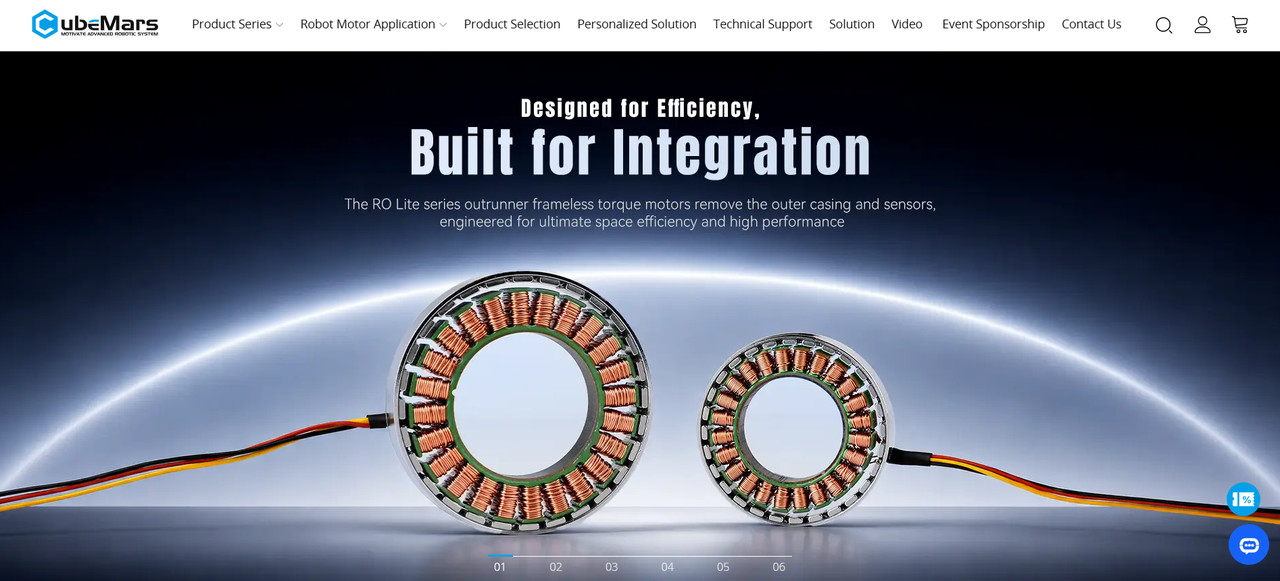
CubeMars, for example, exemplifies this manufacturing belief with the development of its own frameless torque motors, planetary actuator modules and robotic joint systems. With years of motor research and large-scale production capacity, integrated manufacturing helps to ensure consistency of performance standards in a wide variety of robotic applications.
4. Integrated Actuation Systems for Modern Robotics
The trend in robotics is to move away from using multiple components in assemblies and toward using highly integrated actuator modules. Integration enhances the effectiveness and decreases the complexity of the overall system.
In many modern actuator modules, motor technology, reduction systems, sensing elements, and electronics for control are integrated into a single package. This setup saves time during assembly, enhances the communication between the parts, and minimizes installation errors.
Advantages of Integrated Actuation Modules
- Compact architecture supports space-constrained robot designs.
- Integrated encoders improve motion feedback accuracy.
- Reduced wiring simplifies installation and maintenance.
- High torque density supports demanding robotic movements.
- Better component compatibility enhances long-term reliability.
Power, precision, weight and mechanical robustness are important features, especially in humanoid robots, exoskeleton systems and quadruped platforms that require all these features in a small installation space.
5. Why Robot Motor Manufacture Influences Overall System Reliability
Actuators are the subject of much focus, but it starts with good motor engineering. As a key component in efficiency, torque production, heat management and mechanical durability, Robotic Actuator Manufacture is a critical factor.
Modern robots are designed to provide high torque in a small size while efficiently using energy. Frameless torque motors have gained particular importance due to the fact that they do away with unneeded external housings; thus, engineers can embed torque motors directly in the robotic mechanism.
This is because this design offers more flexibility to equipment manufacturers and also contributes to lowering the total system weight. These motors can be coupled with sophisticated planetary transmission systems to achieve seamless torque delivery in challenging operating conditions.
Motor consistency is also a result of long-term manufacturing experience. Firms that have dedicated R&D, testing and manufacturing facilities are more likely to fine-tune magnetic design, winding technology, material selection and precision manufacturing processes. This leads to enhanced stability and control in a wide variety of robotic applications, including industrial robots and sophisticated humanoid systems.
6. Supporting Diverse Robotic Applications Through Advanced Engineering
In the world of robots, some situations demand both power and accuracy. Actuators with high radial load capacity allow for reliable operation in a wide variety of industries with even the best movement quality.
Stable joint performance during walking, balancing and object manipulation is essential for humanoid robots. Exoskeleton systems require actuators that are light, powerful and can assist in repetitive human movement. In the use of robotic arms, positioning accuracy must be guaranteed in the lifting and assembly process, and quadruped robots must have fast dynamic response during the movement of mechanical load which are constantly changing.
Actuator technology has also been continuously improved, and the application areas in industrial automation, research robotics, logistics, medical equipment and intelligent manufacturing are also expanding. Compact high-torque planetary modules, frameless motors and integrated actuator systems offer engineers increased design flexibility, without compromising mechanical reliability.
By continually investing in research, production optimization, and scalable manufacturing, manufacturers help to speed up innovation in these expanding robotics fields.
7. Future Directions in High-Strength Robotic Actuation
Future trends in robotic actuation will involve increased integration, efficiency and structural performance. To address the needs of next-generation robots, engineers are still working on creating lighter materials, smaller transmission systems, and more advanced sensing technologies, and increasingly efficient motor designs.
Future integrated actuator modules will likely be even more capable, with advanced control systems, torque density, thermal performance and durability all further enhanced in increasingly compact designs. With the advancement of more sophisticated robotic platforms, reliable radial load strength will continue to be important for precision, safety and long-lasting operational stability.
Actuator performance will be further influenced by manufacturing improvements such as mass production, close-tolerance quality control, and ongoing engineering improvements.
Conclusion
In the rapidly evolving landscape of modern robotics, the ability to withstand high radial loads is a pivotal feature of any robotic actuator, impacting both stability and precision, as well as durability and mechanical performance. This capability must be attained through careful engineering, incorporating cutting-edge motors, planetary reduction systems, precision manufacture and highly integrated actuator designs.
With the ongoing advances of robotics into more challenging applications, manufacturers are working on more compact, efficient, and reliable actuators to enable more complex motions under significant mechanical loads. The robotics industry is laying solid groundwork for the next generation of intelligent machines through a constant stream of innovation in motor technology, integrated power modules and precision manufacturing.
Read more: Expert Water Filtration Services in Middleton, MA: H2O Care’s Comprehensive Approach
Part Time MBA Singapore: How It Can Help Your Career
Eco-Friendly Packaging: Communicating Corporate Responsibility