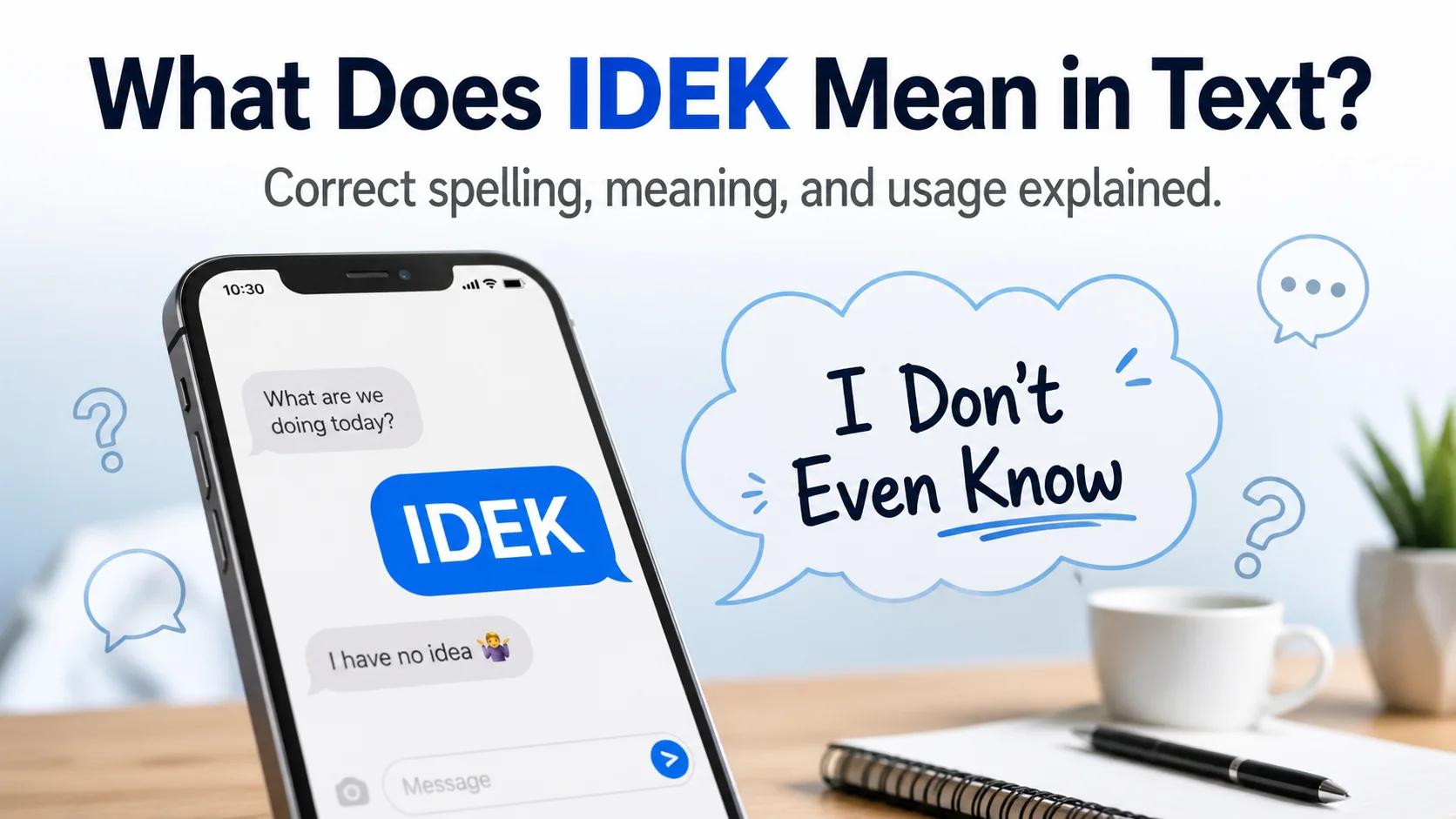
In today’s fast-moving digital world, people often shorten words to save time and keep conversations light. One popular example is “IDEK.” If you’ve seen it in messages or on social media, you might wonder what it really means and why people use it so often.
What Does IDEK Mean in Text is a question many people ask, especially as online language keeps evolving. While it looks simple, this small abbreviation carries emotional tone, cultural meaning, and even subtle social signals—especially in the United States.
Understanding IDEK isn’t just about translation. It’s also about recognizing how Americans express uncertainty, humor, and even frustration through short digital phrases.
Quick Answer
What Does IDEK Mean in Text? In the United States, “IDEK” stands for “I Don’t Even Know.” It expresses confusion, disbelief, or emotional overwhelm, often in a casual or humorous way.
TL;DR
• IDEK means “I Don’t Even Know” • Used to show confusion, surprise, or frustration • Common in American texting and social media • Often carries emotional or sarcastic tone • Reflects modern fast-paced communication habits
What Does IDEK Mean in Texting Conversations?
In everyday American texting, IDEK is a quick way to say you’re unsure or overwhelmed. It often replaces longer explanations with a simple, expressive phrase.
Basic Meaning
IDEK stands for “I Don’t Even Know.” The word “even” adds emphasis, making the feeling stronger than just “I don’t know.”
When People Use It
• When confused about a situation • When overwhelmed by too many choices • When reacting to something surprising • When avoiding a detailed explanation • When joking about chaos or unpredictability
Because of this flexibility, IDEK has become a staple in casual communication across the U.S.
The Evolution of Internet Slang in America
To understand IDEK, it helps to look at how digital language evolved in the United States. Abbreviations didn’t appear randomly—they grew from real communication needs.
Early Digital Language
In the 1990s and early 2000s, people used short forms like “LOL” and “BRB” in chat rooms and texting. These saved time and fit character limits.
Rise of Emotional Abbreviations
Later, phrases like IDEK emerged. These didn’t just save space—they conveyed tone and feeling.
• Early slang focused on actions (BRB, TTYL) • Newer slang expresses emotions (IDK, IDEK) • Social media increased creative expression • Short phrases became identity markers
Today, IDEK reflects a culture where speed and emotion go hand in hand.
Why “Even” Changes the Meaning
The word “even” is small, but it matters a lot. It transforms the phrase from neutral to emotional.
Emotional Amplification
“I don’t know” is simple. But “I don’t even know” suggests something deeper.
• Stronger confusion or disbelief • Feeling mentally overwhelmed • Emotional exhaustion or frustration • Sometimes playful exaggeration
Because of this, IDEK often feels more expressive than IDK.
Symbolism of IDEK in Modern Communication
Although IDEK isn’t a traditional symbol like a heart or star, it still carries symbolic meaning in digital culture.
What IDEK Symbolizes
• Mental overload in a fast-paced world • Casual honesty about uncertainty • Emotional openness in short form • Relatability in shared confusion
In the U.S., it reflects a cultural shift toward being comfortable with not having all the answers.
IDEK Meaning in American Culture
In the United States, communication style tends to be informal and expressive. IDEK fits perfectly into this pattern.
Cultural Context
Americans often use humor and exaggeration to cope with stress. IDEK becomes part of that emotional language.
• Used in casual friendships and texting • Common in memes and online humor • Reflects openness about confusion • Signals a relaxed, informal tone
Because of this, IDEK feels natural in everyday conversations.
Emotional and Psychological Associations
Language shapes how we express feelings. IDEK connects closely to emotional states.
Common Emotional Signals
• Confusion about complex situations • Feeling overwhelmed by information • Mild frustration or disbelief • Playful sarcasm
Interestingly, using IDEK can also reduce pressure. It allows people to admit uncertainty without feeling judged.
IDEK vs IDK: What’s the Difference?
Many people confuse IDEK with IDK. While similar, they are not identical.
Key Differences
ContextMeaning in the USACommon AssociationsNotesIDKSimple uncertaintyNeutral toneBasic lack of knowledgeIDEKStronger confusionEmotional or dramatic toneAdds emphasisIDK responseStraightforward answerInformationalLess expressiveIDEK responseReaction-basedEmotional expressionOften exaggerated
Why It Matters
IDEK feels more personal and expressive, while IDK is more neutral and factual.
How IDEK Is Used on Social Media
Social media platforms helped IDEK grow quickly. It fits perfectly into short posts and reactions.
Common Online Uses
• Reaction to shocking news • Comment on chaotic situations • Caption for relatable memes • Response in group chats
For example, someone might post: “This week has been wild… IDEK anymore.”
This shows how the phrase captures shared feelings in a simple way.
Read This: What Does NGL Mean in a Text?
IDEK in Texting, Dating, and Relationships
IDEK also plays a role in personal communication, especially in texting and dating.
How It’s Interpreted
• Can signal genuine confusion • May show emotional overwhelm • Sometimes used to avoid giving a direct answer • Can feel casual or slightly dismissive
Because tone isn’t always clear in text, context matters a lot when interpreting IDEK.
Cross-Cultural Meanings and Understanding
While IDEK is widely used in the U.S., its meaning can vary slightly in other cultures.
Global Perspective
• English learners may take it literally • Some cultures prefer more direct communication • Tone may be misunderstood without context
However, because American media is global, IDEK is becoming more widely recognized.
Misunderstandings and Potential Misuse
Like many slang terms, IDEK can sometimes be misunderstood.
Common Issues
• Seen as dismissive in serious conversations • Misread as lack of interest • Overuse can reduce clarity • Not suitable for formal settings
Because of this, it’s best used in casual, friendly contexts.
How IDEK Reflects Modern Identity
Language is part of identity. Using IDEK can say something about how a person communicates.
What It Signals
• Comfort with informal language • Openness about uncertainty • Connection to digital culture • Preference for quick communication
In many ways, IDEK represents a generation that values speed, relatability, and emotional honesty.
How the Meaning of IDEK Has Shifted Over Time
Even though IDEK is relatively new, its use has already evolved.
Then vs Now
• Originally meant simple confusion • Now includes humor and sarcasm • Used more creatively in memes • Sometimes exaggerated for effect
This shows how digital language constantly adapts to cultural trends.
FAQs:
What does IDEK stand for in texting?
IDEK stands for “I Don’t Even Know.” It expresses stronger confusion than just “I don’t know.”
Is IDEK rude to use?
Not usually. However, it can feel dismissive in serious conversations if used carelessly.
When should I use IDEK?
Use it in casual chats, social media, or friendly conversations. Avoid it in formal settings.
What’s the difference between IDEK and IDK?
IDK is neutral, while IDEK adds emotional emphasis and stronger confusion.
Is IDEK popular in the USA?
Yes, it’s widely used in texting, memes, and online conversations across the United States.
Can IDEK be sarcastic?
Yes. People often use it humorously or sarcastically, depending on context.
Conclusion:
Language is always changing, and digital communication has accelerated that shift. What Does IDEK Mean in Text goes beyond a simple definition—it reflects how people express emotion, confusion, and humor in a fast-paced world.
In the United States, IDEK has become a natural part of everyday conversation. It signals honesty, relatability, and sometimes even a sense of shared chaos. While it’s casual and flexible, it still requires context to be understood correctly.
As communication continues to evolve, phrases like IDEK remind us that even the smallest words can carry deeper meaning.

Emma Brooke is the voice behind English Sharp Mind, dedicated to helping learners sharpen their English skills with clear explanations, practical tips, and confidence-building guidance.