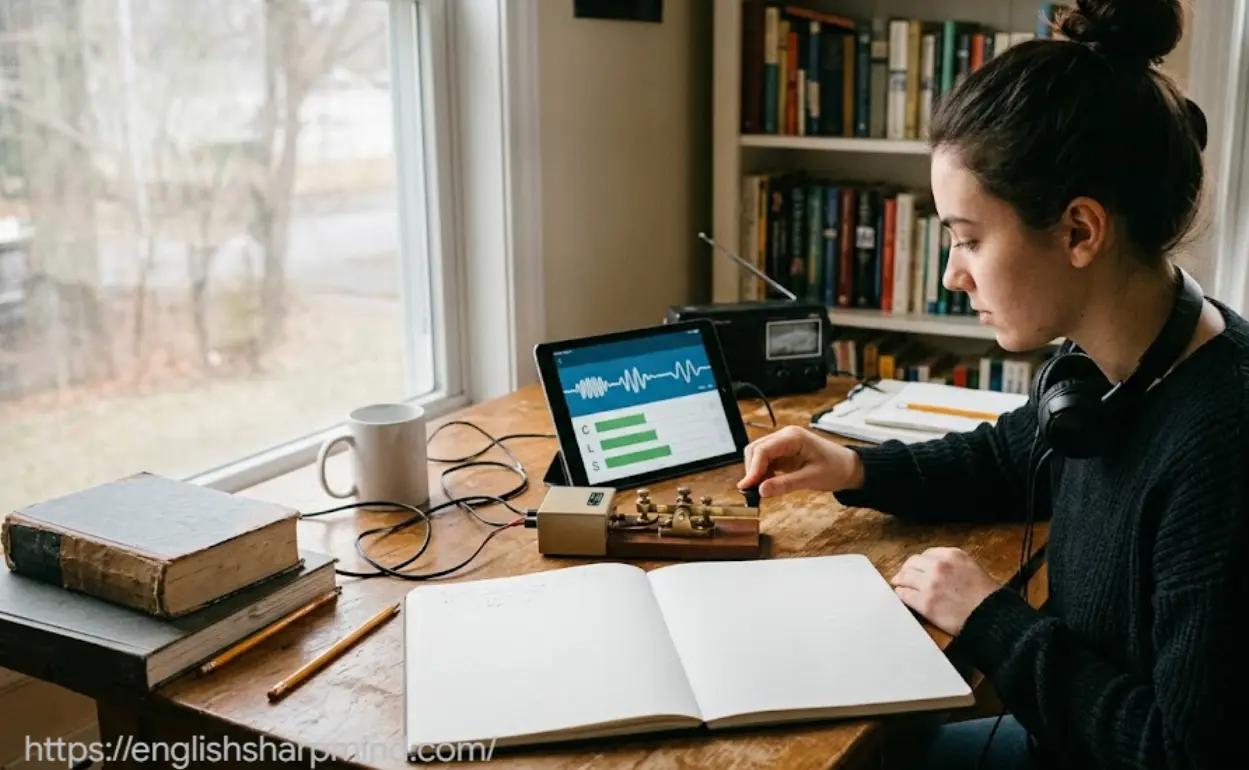
If you’ve ever tried to learn a language, you know the strange stages you pass through. First you decode letter by letter, painfully slow. Then, one day, whole words arrive without effort. Learning Morse code follows exactly the same arc ,and going through it is a small, revealing lesson in how the brain acquires any language at all.
Stop reading letters, start hearing words
The classic beginner mistake in Morse is to memorize a visual chart: A is dot-dash, B is dash-dot-dot-dot, and so on. It feels like progress, but it builds the wrong skill. You end up mentally “spelling” every character, and you hit a hard ceiling around a few words per minute.
Fluent Morse operators don’t hear individual dots and dashes any more than you hear individual letters when someone speaks to you. They hear the shape of a whole character ,and eventually whole common words ,as a single rhythmic unit. This is precisely how reading works in a language you know well: you stopped sounding out letters years ago and now recognize words as shapes.
The lesson transfers directly. In any language, the jump from beginner to intermediate is the jump from decoding units to recognizing patterns.
Rhythm carries meaning
Morse teaches something else that language learners often underrate: timing is not decoration, it’s grammar. The gap between two dots and the gap between two letters and the gap between two words are all different lengths, and getting them wrong turns a clear message into gibberish ,even if every dot and dash is technically correct.
Spoken language works the same way. Pauses, stress, and rhythm carry as much meaning as the words themselves. Learners who master vocabulary but ignore rhythm sound robotic and are hard to understand; learners who master rhythm sound natural even with a smaller vocabulary. Morse makes this usually-invisible principle impossible to ignore.
Use the same tools that work for languages
The methods that make Morse click are the ones that make any language click. Learn by ear, not by chart. Practice in short daily sessions rather than long crams. And get immediate feedback so mistakes don’t harden into habits.
That last point is where a good tool matters. A Morse code translator lets you type a phrase and hear it played back at real speed, so you’re training your ear from day one instead of your eyes. Immediate audio feedback is exactly what language apps discovered years ago: you learn a sound-based system by hearing it, correcting, and hearing it again ,not by staring at a table.
Why the parallel is worth the detour
You will probably never need to send a distress signal by tapping on a pipe. But spending a couple of weeks with Morse gives you a clean, compact demonstration of how fluency is actually built: recognition over decoding, rhythm over raw vocabulary, and feedback over memorization.
It’s a language with only two sounds and no grammar to argue about ,which makes it the perfect sandbox for watching your own brain do the thing it does with every language you’ll ever learn.
Also Read-The Top 5 Fence Companies in Cincinnati, OH for 2026: An Expert Guide