Yes, solar battery backup can work during winter outages, but winter changes the energy schedule around the system. Daylight hours are shorter, the sun follows a lower seasonal path, and household electricity use may follow a different pattern from summer. A useful winter backup plan therefore looks beyond the battery alone. It considers where the system operates, when solar energy is available, how household demand changes across a cold day, and how energy can be replenished if an outage continues overnight or into the following day.
Plan Around the Shape of a Winter Day
Cold-Weather Operation Starts With the System Location
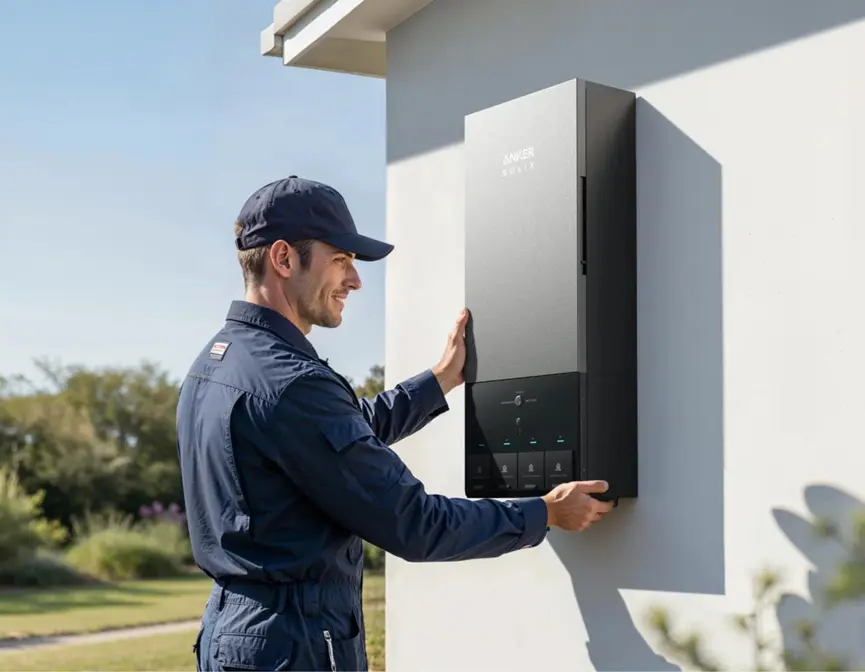
Winter planning begins before an outage occurs. The battery system’s operating temperature range should suit the environment where it will be installed. Anker SOLIX E10 has a specified operating range of -4°F to 131°F (-20°C to 55°C), which provides a clear reference when planning its location. Installation format also matters. E10 supports both wall and floor mounting, allowing the physical setup to reflect the property and local conditions. Rather than treating winter readiness as a feature that becomes relevant only when snow arrives, include climate and installation conditions in the original system design. This gives a battery backup for home a defined operating environment before it is ever asked to carry the household through winter weather.
Shorter Days Change the Solar Schedule
Solar panels can still produce electricity during winter daylight, so winter backup planning should focus on when that energy arrives. The useful solar window may be concentrated into fewer hours than during longer summer days. That makes timing important. Electricity collected around midday can support current household demand, replenish stored energy, or contribute to both depending on the system and conditions. E10 accepts up to 9 kW of solar input per unit through dual 30V–450V MPPTs. With three E10 units and Power Dock, maximum solar input reaches 27 kW. With CT, E10 can also work with an existing solar system. The practical objective is to make productive daylight hours part of the outage plan rather than relying only on the battery’s starting charge.
Winter Demand Has Its Own Daily Rhythm
A cold-weather household may use electricity differently throughout the day. Morning routines can create a cluster of activity as people wake, prepare food, use hot water-related equipment where applicable, and begin work or school. Daytime demand can settle into another pattern before rising again during the evening when more people occupy the home, lighting use increases, and cooking begins. Overnight creates another distinct period. Mapping these winter blocks makes backup planning more accurate than applying one average power figure to all 24 hours. It also keeps the analysis focused on real behavior. The system needs to serve the home that exists at 7 a.m., 2 p.m., and 8 p.m., not an imaginary household with perfectly constant demand.
Connect One Winter Day to the Next
Treat Sunset as an Energy Handoff
Winter sunset creates a natural boundary in a solar-backed outage. During daylight, incoming solar energy may contribute to household operation and battery replenishment. After sunset, stored energy takes a larger role until solar production resumes the following day. Thinking of sunset as an energy handoff makes planning more concrete. Households can consider how much capacity they want available when daylight ends and which activities will occur during the evening and overnight. E10 offers 6 to 30 kWh of battery capacity per unit and can expand to 90 kWh with three units and Power Dock. That scalable capacity can be matched to the desired overnight reserve and the broader winter backup plan.
Morning Becomes the Key Link Between Two Solar Windows
For a winter outage that crosses midnight, the hours before the next useful solar period deserve special attention. They connect yesterday’s stored energy with tomorrow’s incoming generation. Instead of viewing an overnight outage as one uninterrupted block, divide it at sunrise. Ask what the household needs from sunset through sleeping hours, then what it needs during the morning before solar contribution increases. This approach creates a clearer reserve target. It also prevents winter planning from becoming a simple discussion of battery size. Capacity determines how much energy can be stored, while the household schedule determines when that energy is valuable. The goal is to reach the next productive charging window with the required household functions still supported.
Add Another Energy Source for Longer Winter Events
A winter backup strategy can extend beyond the repeating cycle of battery discharge and solar replenishment. E10 also supports 4.5 kW Smart Generator charging, creating another route for adding energy during a prolonged interruption. This allows a longer winter event to be viewed as a sequence of energy inputs rather than one long draw on the battery. Stored capacity can carry one period, solar can contribute when daylight becomes productive, and generator charging can provide another source when incorporated into the system. That multi-source structure is especially relevant to winter planning because the objective changes from estimating one fixed runtime to coordinating available energy across successive days and nights while household demand continues to evolve.
Conclusion
Solar battery backup can operate during winter outages when the system and household energy plan account for the season’s distinct timing. Winter introduces a different daily rhythm: cold-weather operating conditions, concentrated daylight, changing household demand, sunset, overnight consumption, and the next solar window. Planning around these stages makes stored energy and incoming generation easier to coordinate. With suitable operating conditions, expandable capacity, solar input, and additional charging options, a backup system can form part of a structured winter energy plan that continues beyond a single day.
Read More
- https://englishsharpmind.com/what-victorian-businesses-should-check-before-going-solar/
- /choosing-the-right-iron-boundary-design-for-your-home/
- when-specialist-palliative-care-at-home-makes-sense/